
Why fabric samples matter for custom window treatments
TL;DR:Request physical fabric samples to accurately evaluate color, texture, and light transmission.Comparing fabric GSM helps match materials to specific room privacy and insulation needs.Handling samples reduces the risk of costly returns and ensures functional, aesthetic window treatments.
Ordering curtain fabric from an online photo feels straightforward until the bolt arrives and the color is three shades off, the texture is stiffer than expected, or the fabric lets in far more light than the description suggested. This happens to homeowners constantly, and it almost always comes down to one missed step: requesting physical fabric samples before committing to a purchase. Samples let you evaluate color under your home’s actual lighting, feel the weight and drape of the material, and test how much light passes through. This guide explains what fabric samples reveal, how to use them effectively, and how they lead to window treatments you will genuinely love.
Table of Contents
- What are fabric samples and why are they important?
- How fabric samples help you choose the right material
- Comparing types of window treatment fabrics: Sheer, medium, and heavy
- Tips for homeowners: How to request and evaluate fabric samples
- Why the conventional approach to fabric selection isn’t enough
- Ready to request fabric samples? Where to start
- Frequently asked questions
Key Takeaways
| Point | Details |
|---|---|
| Requesting samples reduces mistakes | Touching and seeing fabric before purchase prevents wrong choices and saves money on returns. |
| GSM guides your decision | Comparing GSM benchmarks helps you match fabrics to privacy and insulation needs. |
| Physical comparison beats digital | Actual samples reveal color, texture, and performance in your home environment more accurately than online images. |
| Expert tips improve outcomes | Testing samples at different times and recording your impressions lead to better custom window treatments. |
What are fabric samples and why are they important?
Fabric samples are small, physical swatches of textile that retailers or manufacturers provide so you can evaluate a material before ordering yardage. They are typically several inches square, though some suppliers offer larger cuttings to give a better sense of drape and pattern repeat. The purpose is simple: no digital image, no matter how high-resolution, can fully communicate how a fabric feels, how it moves, or how its color behaves under different light conditions.
When homeowners rely on product photos and written descriptions alone, they are working with a very incomplete picture. A product page might describe a fabric as “ivory with a subtle sheen,” but that tells you nothing about whether the sheen looks warm or cool under your kitchen’s natural light, or whether the ivory reads as cream or stark white next to your trim. A physical swatch placed directly against your wall color, flooring, and existing furnishings resolves that ambiguity immediately.
The practical benefits of handling samples before ordering include:
- Accurate color matching under your home’s specific lighting conditions, whether that is warm incandescent, cool LED, or natural daylight
- Tactile texture assessment, which reveals whether a fabric is smooth and sleek, nubby and casual, or structured and formal
- Light opacity testing, which lets you hold the swatch to a window to gauge how much privacy or light filtration the finished curtain will actually provide
- Drape evaluation, especially important for floor-length drapery where how a fabric falls determines the overall aesthetic
- Durability check, since you can assess thread density and weave tightness by feel in a way that no product description reliably conveys
“Texture, opacity, and drape are properties that only physical evaluation can confirm. A photograph captures color and surface appearance, but it cannot replicate how a fabric responds to touch or light in your specific space.”
Industry data backs this up. U.S. textile suppliers that adopted quantitative fabric metrics like GSM (grams per square meter) and stretch percentage on sample tags saw a 42% drop in product returns compared to retailers using subjective language alone. That figure is significant because returns are expensive and disruptive, especially for custom-cut fabric that cannot be resold.
For homeowners investing in custom window treatments, reading window treatment fabric tips before ordering samples gives you a solid foundation for evaluating what you receive.
How fabric samples help you choose the right material
Once you understand why samples matter, the next step is learning how to use them to compare the specific qualities that affect how your window treatment performs. The most important technical property to understand is GSM, which stands for grams per square meter. GSM is a standardized measurement of fabric weight and density. It tells you, in objective terms, how heavy or light a textile is, which directly predicts its performance in terms of privacy, light control, and insulation.
GSM benchmarks for curtain and drapery fabrics generally fall into three categories:
| GSM range | Fabric type | Typical use |
|---|---|---|
| Under 100 GSM | Sheer, airy (voile, organza) | Soft light diffusion, decorative layering |
| 150 to 250 GSM | Medium weight (cotton, linen) | Balanced privacy and natural light |
| Over 300 GSM | Heavy (velvet, blackout lining) | Strong insulation, sound reduction, full privacy |
When you have physical samples in hand, you can cross-reference their labeled GSM with your actual functional needs. A room where you want gentle morning light but moderate privacy calls for something in the 150 to 250 GSM range. A bedroom where you need full darkness to sleep calls for something above 300 GSM, ideally with a blackout weave or bonded lining.
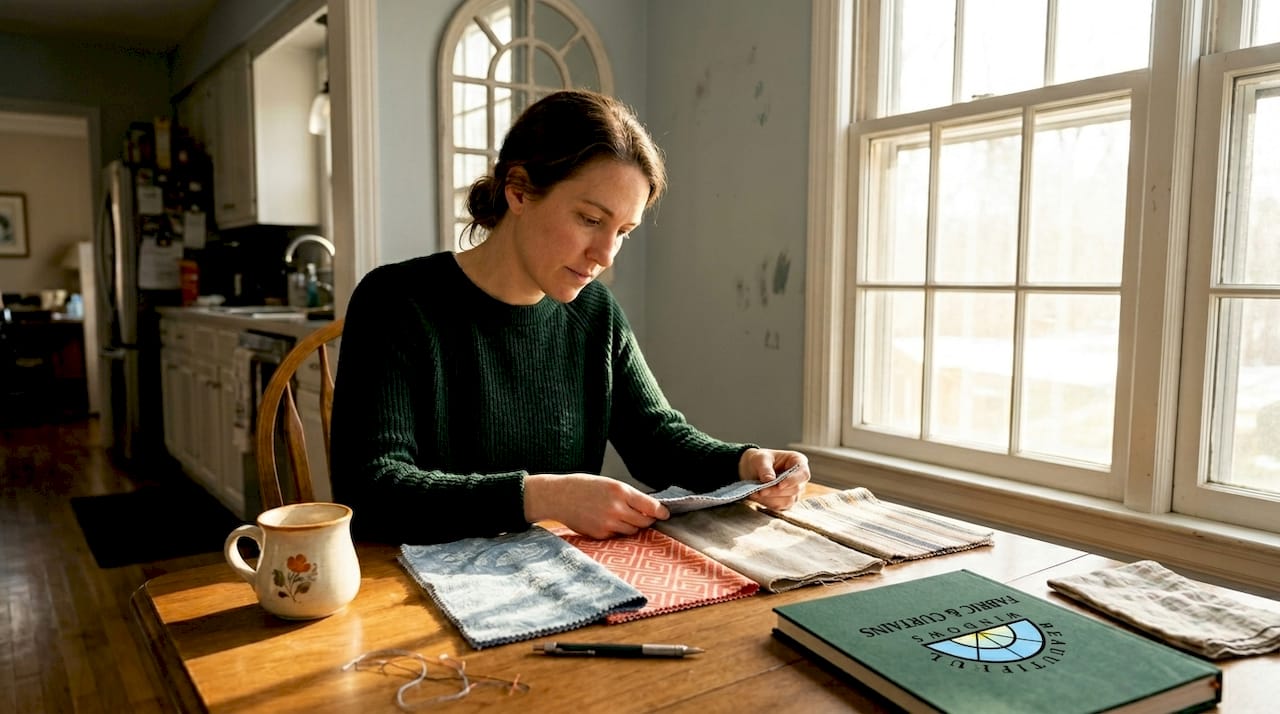
Comparing samples side by side, rather than simply reading descriptions, also lets you notice subtler differences. Two fabrics might both be labeled “medium weight cotton,” yet one might feel noticeably stiffer and less likely to drape softly, while the other has a flowing quality that works better for floor-length panels. You can test stretch, which matters for upholstered treatments and Roman shades, and you can feel whether the weave is tight and durable or loose and prone to snagging.
Understanding the full range of curtain fabric types helps you know what to request, and consulting a curtain selection guide before ordering narrows your options to the most appropriate categories for your specific rooms.
Pro Tip: Place your samples against the window at different times of day. Morning light, afternoon light, and evening artificial light each change how a fabric’s color reads and how much it filters or transmits. A swatch that looks perfect at noon may feel too warm or too cold under evening lamp light.
Comparing types of window treatment fabrics: Sheer, medium, and heavy
Fabric for window treatments falls into three broad functional categories, and samples are the clearest way to experience the real-world differences between them. Each category serves distinct purposes, and understanding those purposes before you select your material prevents costly mistakes.
Sheer fabrics typically measure below 100 GSM and include materials like voile, batiste, and lightweight organza. These fabrics let generous amounts of natural light pass through while softening the view from outside. They work well in living rooms and dining spaces where light is welcome and full privacy is not required. When you hold a sheer sample to a window, you will immediately see that it diffuses rather than blocks light, creating a gentle, luminous quality in a room.
Medium-weight fabrics in the 150 to 250 GSM range include woven cotton, linen, and many decorative jacquard patterns. These offer a practical balance between light filtration and visual privacy during daylight hours. They are the most versatile category for living areas, kitchens, and home offices where you want some control over light without blocking it entirely. A cotton or linen sample will feel substantial in your hand, hold its shape well, and drape cleanly without being stiff.
Heavy fabrics above 300 GSM include velvet, chenille, and blackout-lined materials. These serve as genuine thermal and visual barriers. They reduce heat transfer through windows in both summer and winter, which lowers energy costs. They also absorb sound, making them valuable in rooms that face busy streets or have hard flooring that generates echo. A velvet or blackout sample will feel noticeably dense and weighty, and when you hold it to a light source, very little or no light passes through.
Here is a practical step-by-step process for comparing your samples across all three categories:
- Lay all samples flat against a neutral white surface to compare their base colors accurately without background interference.
- Hold each sample to the window during daylight and note how much light passes through, from fully transparent to completely opaque.
- Drape each sample over the edge of a table or curtain rod to observe how it falls and whether the hang feels graceful or stiff.
- Feel the back surface of each sample, since the texture and density on the reverse face affects how the fabric interacts with lining material.
- Check the labeled GSM or ask the retailer to provide it, then match that number against your room’s functional requirements.
Exploring a detailed drapery fabric selection guide gives you additional context for how different fabric weights perform in real installations.
Tips for homeowners: How to request and evaluate fabric samples
Requesting fabric samples is a simple process, but doing it strategically maximizes its value. The goal is to gather enough material to make a genuinely informed decision without ordering so many swatches that the comparison becomes overwhelming.
Start by identifying the rooms and windows you are treating, then narrow your shortlist to fabrics that match both the aesthetic and functional requirements of each space. Most quality retailers and custom drapery services offer samples on request, either for free or for a modest fee that is often credited toward a future order. When requesting samples, ask specifically for swatches that include printed or embossed GSM information, since that single number gives you immediate objective context.
When your samples arrive, evaluate them using the following checklist:
- Color accuracy: Compare the swatch to your wall color, trim, and flooring under natural light and artificial light at different times of day.
- Texture and hand feel: Run your fingers across the surface to assess smoothness, nap, or weave texture, and determine whether the tactile quality matches your room’s tone.
- Light opacity: Hold the sample to your window and observe how much light passes through, rating it on a simple scale from fully transparent to fully blackout.
- Stretch and recovery: Gently pull the sample horizontally and vertically to see if it has any stretch and whether it returns to shape, which matters for certain pleat styles and Roman shades.
- Drape quality: Fold the sample loosely and let it fall to observe whether it creates fluid, soft folds or holds a rigid crease.
Pro Tip: Keep a simple notebook or use your phone’s notes app to record your observations for each sample. Note the fabric name, GSM, your color assessment, and your opacity rating. When you have five or six samples, written notes make comparison far easier than relying on memory alone.
Industry research confirms that homeowners who evaluate quantitative fabric data like GSM and stretch during the sample phase make purchasing decisions with significantly greater confidence, contributing to that 42% reduction in returns among U.S. textile buyers.
Common pitfalls to avoid include ordering samples from only one supplier before comparing with alternatives, ignoring the back face of the fabric when assessing lining compatibility, and evaluating color under store or screen lighting rather than in your actual room. A thorough curtain style selection process helps you align your sample evaluation with the specific treatment style you are planning, and guidance on choosing drapery fabric ensures your final selection suits both function and form.
Why the conventional approach to fabric selection isn’t enough
There is a persistent assumption in home decorating that color swatches from paint companies and fabric thumbnails from retailer websites are sufficient for making confident purchasing decisions. They are not, and the consequences of relying on them are more significant than most homeowners anticipate.
Custom window treatments represent a meaningful financial investment. Fabric sold by the yard, professionally sewn, and custom installed is not the kind of purchase you can easily undo if the color or weight turns out wrong. Yet many homeowners place orders based on a product photo taken in a studio under controlled lighting, often edited to enhance saturation and contrast. That photo may have no relationship to how the fabric looks in your space.
The deeper issue is that fabric selection for window treatments is as much about function as it is about aesthetics. A fabric that looks beautiful in a photograph may be completely unsuited to its intended role. A sheer voile in a stunning floral pattern will not give a bedroom the privacy or darkness needed for restful sleep. A heavy velvet in a rich jewel tone will overwhelm a small, light-filled breakfast room. These mismatches are only apparent when you handle the material and test it in the actual space.
We have seen, time and again, that homeowners who invest in the sample step approach their final fabric decision with genuine confidence rather than hope. They understand the role of fabric in window treatments at a functional level, not just a visual one. They have held the fabric, watched light interact with it at different hours, and compared it directly against their room’s palette. That tactile, firsthand experience produces better outcomes and, critically, eliminates the frustration and expense of returns, reorders, and reinstallations.
Relying solely on descriptions is not a personal failure. It is simply an incomplete method that the home décor industry has been slow to address. Requesting samples before committing to any significant fabric purchase is not an extra step. It is the only reliable step.
Ready to request fabric samples? Where to start
Choosing the right fabric for your custom window treatments becomes far more straightforward when you can see and feel the material in your own space.
At Beautiful Windows Elgin, we offer a carefully curated selection of premium designer fabrics, including jacquard satin, embroidered textiles, and upholstery-grade materials, sold by the yard with nationwide shipping. Requesting samples is the ideal first step before placing any custom order, and our team is available to guide you through fabric selection, treatment styles, and installation considerations. Whether you are a homeowner planning your first set of custom drapes or an interior designer sourcing materials for a client project, we provide the expertise and resources to support confident decisions from sample to finished installation.
Frequently asked questions
How do fabric samples help reduce returns?
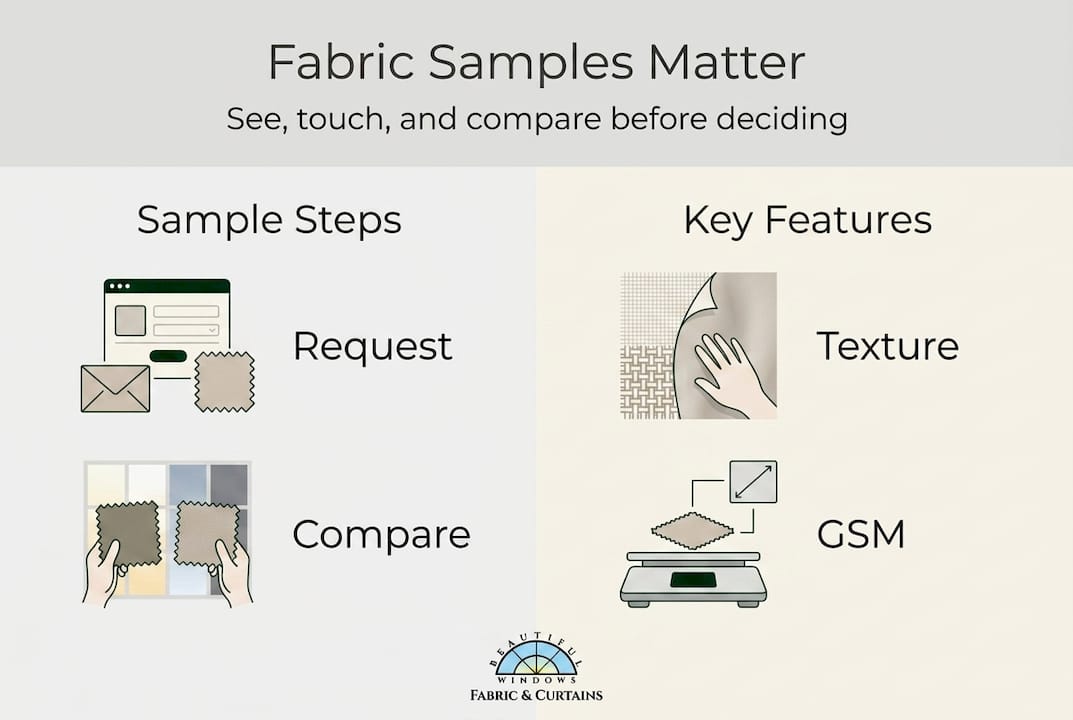
Seeing and touching fabric samples lets you make more confident choices, leading to a 42% drop in returns compared to ordering based solely on pictures and descriptions.
What is GSM and why does it matter when requesting samples?
GSM tells you how heavy or light a fabric is, with lower GSM being sheer and airy and higher GSM providing more insulation and privacy. Curtain fabric GSM benchmarks range from under 100 for sheers to over 300 for heavy blackout materials.
How many samples should I request before making a decision?
It’s best to request at least three to five samples so you can compare colors, textures, and weight side by side and identify which material genuinely suits your space and functional needs.
Is there a way to test fabric samples for privacy and insulation?
Hold the sample directly against your window during daylight hours to assess light opacity, and check the GSM value for insulation potential. Higher GSM means better coverage and stronger thermal performance.
Recommended
- 7 Essential Window Treatment Fabric Tips for Homeowners – Shop Designer Fabrics by the Yard | Curtains & Drapery
- Why Custom Window Treatments Matter for Homes – Shop Designer Fabrics by the Yard | Curtains & Drapery
- Custom window treatments 2026: style meets smart function – Designer Fabrics by the Yard | Drapery Making Services
- Drapery Fabric Selection Guide for Custom Window Treatments – Shop Designer Fabrics by the Yard | Curtains & Drapery