
Window decor terms every homeowner should know

TL;DR:Understanding industry terms helps homeowners communicate clearly and avoid costly mistakes.Proper terminology guides effective fabric and style choices to match room function and aesthetic.Fluency in window decor language empowers better negotiation, design control, and project outcomes.
Shopping for window treatments can feel like stepping into a conversation where everyone else learned the vocabulary except you. Terms like “return,” “header,” “interlining,” and “sheer” get tossed around freely in quotes and fabric listings, leaving many homeowners unsure whether they are ordering exactly what they imagined. This guide cuts through that confusion. By learning the core industry terms and what they actually mean for your space, you can communicate clearly with designers, order with confidence, and make smarter decisions from fabric selection all the way through installation.
Table of Contents
- Why industry terms matter in window decor
- Key window decor terms explained
- Comparing fabrics and finishes: Polyester vs. linen and beyond
- Choosing the right window decor for your space
- What most guides miss about window decor lingo
- Bring your window decor vision to life
- Frequently asked questions
Key Takeaways
| Point | Details |
|---|---|
| Mastering key terms | Learning the basic language of window decor leads to smarter planning and fewer mistakes. |
| Fabric choices matter | Each material has unique benefits, so choose based on lifestyle, maintenance, and design goals. |
| Industry trends | Blinds and shades are practical and efficient, while drapery provides luxury and warmth. |
| Clarity drives results | Clear communication with suppliers and designers is only possible when you know the correct terminology. |
Why industry terms matter in window decor
Window decor is one of the few home improvement categories where a single misunderstood word can result in a costly redo. Order the wrong header style and your drapes may pucker oddly at the top. Confuse “sheer” with “semi-sheer” and you sacrifice the privacy level you were counting on. These are not small inconveniences; they affect the way a room feels every single day.
Understanding window treatment vocabulary also changes the dynamic with design professionals. When you walk into a conversation knowing the difference between a “panel” and a “pinch pleat,” a skilled workroom or vendor treats your project with more precision. You become a collaborator rather than someone who simply receives suggestions. The result is usually more accurate orders, fewer revisions, and tighter budget control.
There is also a functional layer to consider. Window treatments serve multiple purposes beyond appearance:
- Light control: Managing how much sunlight enters, and at what angle
- Privacy: Preventing sightlines from the outside, especially at night
- Insulation: Reducing heat loss in winter and heat gain in summer
- Sound absorption: Heavier fabrics soften echo in hard-floored rooms
- Aesthetics: Framing windows and anchoring the visual design of a room
These functions are embedded in the terminology. Blinds and shades command a 38 to 57 percent market share precisely because buyers associate those category names with practical benefits like energy savings and easy light adjustment. Draperies, on the other hand, carry associations of softness and luxury. When you know the vocabulary, you can match function to fashion far more deliberately.
Knowing what to ask for is half the work of any successful window decor project. The right words lead to the right outcome, from the showroom floor to the final installation.
Our window treatment terminology guide expands on this foundation with additional detail that supports more complex projects.
Key window decor terms explained
Armed with the importance of clear terminology, let’s spell out what these commonly used industry terms really mean and where they fit in your project. Each entry below focuses on practical use so you know how each term shapes a buying decision.
| Term | What it means | Best use |
|---|---|---|
| Drapery / drapes | Fabric panels, usually floor-length, that hang from a rod or track | Formal rooms, living areas, bedrooms |
| Curtains | Lighter panels, often shorter, hung on a rod | Casual spaces, kitchens, dining areas |
| Sheers | Lightweight translucent fabric panels that diffuse light | Layered with heavier panels for day/night control |
| Blinds | Adjustable hard slats (wood, faux wood, aluminum) | Kitchens, bathrooms, offices |
| Shades | Soft fabric that rolls, folds, or stacks when raised | Bedrooms, nurseries, media rooms |
| Valance | A short decorative treatment at the top of a window | Used alone or to conceal hardware |
| Header | The top finishing detail of a drapery panel | Defines the style: pinch pleat, grommet, rod pocket |
| Lining | A backing layer sewn into drapery or shades | Adds insulation, light block, and fabric protection |
| Return | The portion of a rod or board that extends back to the wall | Prevents light gaps at the sides of a panel |
| Interlining | A middle layer between face fabric and lining | Adds body, fullness, and thermal performance |
Drapery deserves extra attention because it is often used interchangeably with “curtains,” which creates real confusion. Professionally speaking, drapery refers to lined, floor-length panels constructed with intentional fullness, typically 2 to 2.5 times the window width, for a tailored, structured look. Drapery is preferred for custom luxury and softness, even though it requires more maintenance than shades or blinds.
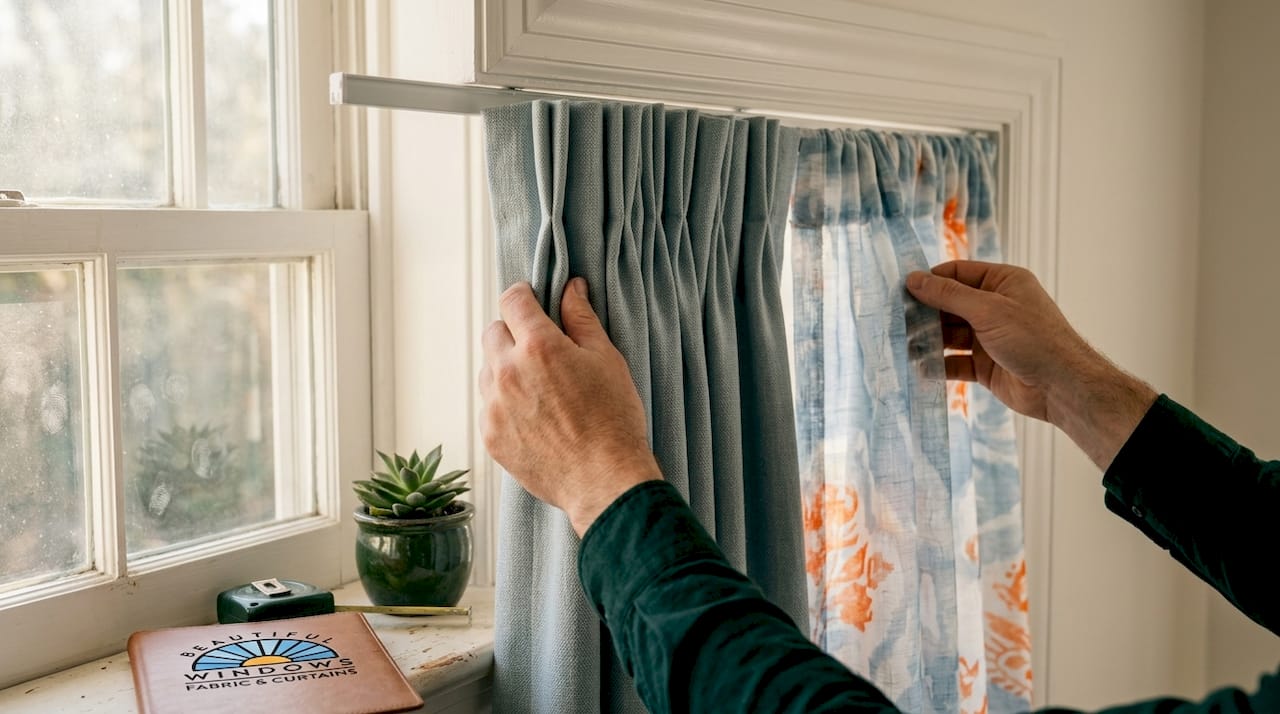
Sheers are a nuanced category. A sheer panel provides daytime privacy by diffusing the view while still allowing natural light to enter. A semi-sheer allows a little more visibility. A privacy sheer is thicker and limits sightlines even in daylight. These are not interchangeable terms. Specifying the wrong one can leave a bedroom exposed or a living room feeling darker than intended.
Headers are one of the most overlooked terms in drapery construction. The header is the structural and decorative top of the panel. A pinch pleat header creates evenly spaced fabric folds and delivers a classic, tailored appearance. A grommet header uses metal rings along the top for a modern, casual drape. A rod pocket threads the rod directly through a sewn channel, creating soft gathered fabric suitable for lighter curtains. The header style affects how the panel moves, how much light it blocks at the top, and how formal or relaxed the final look appears.
Understanding the role of window treatments in home comfort helps connect these definitions to real design outcomes, particularly for energy efficiency and acoustic control.
Pro Tip: When ordering custom drapery, always ask for the “finished width” and “finished length” specifications in writing. These numbers reflect the panel after construction, not the fabric yardage used. Misreading either dimension is one of the most common reasons custom panels need to be remade.
Comparing fabrics and finishes: Polyester vs. linen and beyond
Once you recognize key drapery and hardware terms, the next confusion is often choosing the right material. Let’s compare your main fabric options and break down what is behind each label.
| Fabric | Durability | Maintenance | Aesthetic | Best for |
|---|---|---|---|---|
| Polyester | High | Machine washable, low care | Versatile, wide color range | High-traffic rooms, families with pets |
| Linen | Medium | Dry clean or gentle wash, wrinkles easily | Organic, textured, casual luxury | Living rooms, bedrooms, coastal interiors |
| Cotton | Medium | Machine washable, fades over time | Clean, crisp, approachable | Kitchens, casual dining, children’s rooms |
| Velvet | Medium-High | Professional cleaning recommended | Rich, formal, excellent light block | Formal living rooms, home theaters |
| Jacquard | High | Dry clean preferred | Intricate woven pattern, refined | Traditional and transitional interiors |
| Sheer polyester / voile | High | Machine washable | Lightweight, airy | Layered over heavier panels |
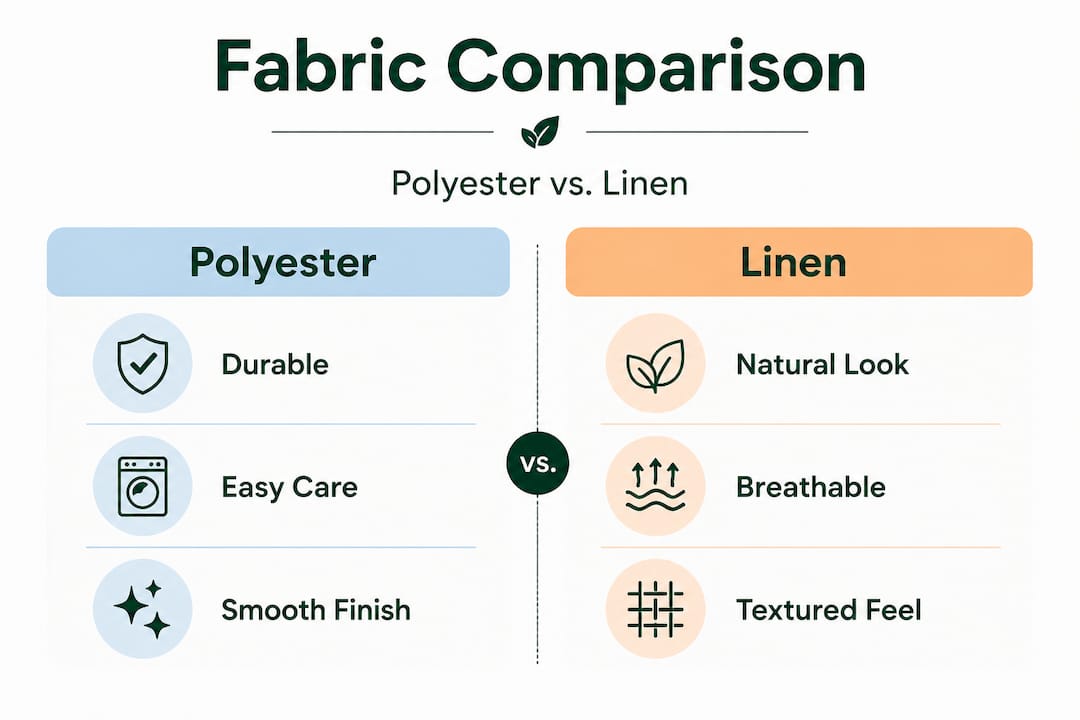
Polyester offers superior durability while linen provides an organic look prized by designers seeking a relaxed, upscale effect. This trade-off sits at the center of most fabric decisions. Polyester holds color well, resists fading from sun exposure, and tolerates repeated washing without losing its shape. For households with children, pets, or rooms that receive heavy sunlight, polyester performs reliably year after year.
Linen behaves differently. It has a natural, slightly uneven texture that reads as effortlessly refined in the right interior. However, linen wrinkles easily and can shrink if not handled carefully during cleaning. For a formal sitting room with controlled light exposure, linen’s aesthetic value can outweigh its maintenance demands. For a sun-drenched breakfast nook, polyester is the practical choice.
Velvet is a category worth understanding separately. A velvet drapery panel can reduce outside noise by up to 50 percent compared to a thin cotton panel in the same space, making it a genuine acoustic treatment as well as a style element. Velvet is also one of the best fabrics for full light block when paired with an interlining, because its dense pile allows little light penetration even without a blackout lining.
Key considerations when comparing fabrics:
- Fade resistance: Polyester and solution-dyed acrylic resist fading; linen and cotton may need UV-protective lining
- Weight and drape: Heavier fabrics like velvet or jacquard hang with natural fullness; sheers need rod tension or weights at the hem
- Pattern repeat: Woven jacquard patterns and printed linens require extra yardage to match repeats at seams
- Eco-friendliness: Linen is biodegradable; recycled polyester blends offer a more sustainable option in synthetic fabrics
Following the fall window treatment trends helps align fabric choices with current design directions, particularly the growing preference for warm textures and layered treatments.
Choosing the right window decor for your space
With fabric and function clear, your next question is: what window treatment style fits best? Here is how to put your knowledge into practice.
- Define your primary function first. Before choosing any fabric or style, decide what the treatment needs to do. If blackout performance is critical, a lined or interlined drapery or a cellular shade rated for light blocking is your starting point. If airflow and natural light are the priority, an unlined sheer or a solar shade with a low openness factor achieves that balance.
- Assess your room’s style register. Formal rooms with high ceilings call for floor-to-ceiling drapery with structured headers like pinch pleats or goblet pleats. Casual rooms benefit from grommet panels or relaxed rod-pocket curtains. The architectural character of the room should guide the formality level of the treatment.
- Set a realistic budget that accounts for yardage, construction, and hardware. A common budget mistake is pricing the fabric per yard without calculating the total yardage needed for fullness, pattern repeats, and hem allowances. A window requiring two 96-inch panels at 2.5 times fullness may need 10 to 12 yards of fabric before a single seam is sewn.
- Layer for flexibility. Blinds and shades dominate the market for energy savings and practicality, yet layered drapery creates warmth and luxury that no shade alone can replicate. A practical approach combines a roller shade or cellular shade for daily light control with a drapery panel for softness, privacy, and style.
- Think about installation requirements. Inside-mount treatments sit within the window frame and create a clean, minimalist look. Outside-mount treatments attach to the wall above and beyond the frame, making windows appear larger and blocking more light at the edges. Know which approach suits your window before ordering.
Pro Tip: Mount your curtain rod 4 to 6 inches above the window frame and extend it 6 to 12 inches beyond each side of the frame. This simple adjustment makes windows look taller and wider without any structural changes, and it dramatically improves the perceived proportion of a room.
Exploring options for tailored warmth and texture provides additional direction for those balancing current design trends with long-term livability.
What most guides miss about window decor lingo
Most terminology guides treat industry vocabulary as a reference list. Memorize the terms, check the box, move on. That framing misses the more meaningful benefit: knowing this language gives you creative control and negotiating confidence that most homeowners never experience.
When you visit a fabric showroom or speak with a custom workroom and you refer accurately to “interlining,” “finished width,” and “return measurement,” the conversation shifts. Vendors allocate more care to your project because they can see you will notice imprecision. That attention often translates to better workmanship without a premium price.
There is also a cost protection angle that rarely gets discussed. Misused or vague terminology in a custom order creates an opening for interpretation. If you order “lined drapes” without specifying the lining type, you may receive a thin cotton lining when you expected blackout or thermal lining. The resulting dispute is difficult to resolve because the written order technically matches what was delivered. Precise language eliminates that ambiguity before a single yard is cut.
Finally, terminology fluency opens up design possibilities that you might otherwise overlook. A homeowner who knows what an “interlining” is can intentionally specify it in lightweight linen to achieve the structured, weighty drape of velvet without its visual heaviness. That is a design solution most catalogs will never suggest. Understanding window treatments for home comfort in this way moves you from reactive shopper to intentional designer.
The vocabulary is not an obstacle. It is a toolkit. Every term you learn is a precise instruction you can give, a specification you can verify, and a design outcome you can control.
Bring your window decor vision to life
Turning your knowledge into a finished room starts with access to quality materials and reliable guidance. At Beautiful Windows Elgin, we offer a curated selection of designer fabrics, including jacquard satin, embroidered textiles, and premium upholstery-weight options, sold by the yard with nationwide shipping available.
Whether you are planning a custom drapery project or sourcing fabric for a DIY installation, our team provides design consultation support and professional guidance at every stage. From fabric samples to finished measurements, we help you apply the terminology you have learned to real, well-executed results. Browse our fabric collections and custom drapery services at beautifulwindowselgin.com to find the materials that match your vision precisely. Every fabric choice you make is supported by expert knowledge and a commitment to quality that shows in the finished treatment.
Frequently asked questions
What’s the difference between blinds and drapes in industry terms?
Blinds consist of adjustable hard or soft slats that control light and privacy through tilt and lift mechanisms, while drapes are fabric panels valued for softness and decorative presence. Blinds and shades dominate the market for practicality, while drapery is prized for luxury and refined aesthetics.
Are polyester window treatments better than linen?
Neither material is universally better; the right choice depends on your room’s conditions and priorities. Polyester is valued for durability and easy care, while linen is chosen for its organic aesthetic and upscale texture in lower-traffic settings.
What does “lining” mean in window decor?
Lining refers to a secondary fabric layer sewn to the back of a drapery panel or shade, providing insulation, improved light control, and protection for the face fabric against sun damage.
Do industry terms really impact the final result?
Yes, consistently. Precise terminology ensures that what you specify in an order matches what is constructed and installed, reducing the risk of mismatches in dimension, style, or material performance.
How do I know which window covering term applies to my project?
Start by identifying your room’s primary needs: privacy, light control, insulation, or decorative style. Then match those needs to the product category whose definition describes those functions, and select a fabric and header style that suits your design intent.
Recommended
- Fall Window Treatment Trends 2025: Warmth, Texture Tailored Elegance – Shop Designer Fabrics by the Yard | Curtains & Drapery
- Fall Window Treatment Trends 2025: Warmth, Texture Tailored Elegance – Shop Designer Fabrics by the Yard | Curtains & Drapery
- Fall Window Treatment Trends 2025: Warmth, Texture Tailored Elegance – Shop Designer Fabrics by the Yard | Curtains & Drapery
- Fall Window Treatment Trends 2025: Warmth, Texture Tailored Elegance – Shop Designer Fabrics by the Yard | Curtains & Drapery
- How to create artful interiors with diamond painting