
Blackout curtains: 8 advantages for sleep and comfort

TL;DR:Blackout curtains effectively improve sleep, reduce heat gain, and dampen outside noise when properly chosen and installed. Their performance depends on fabric quality, fit, and routine use, making correct system implementation essential. Proper fitting and layering maximize benefits, providing a comfortable, energy-efficient, and private home environment.
Choosing the right window treatment should be straightforward, but the options feel anything but simple. Blackout curtains appear on every “best bedroom upgrade” list, yet many homeowners still wonder whether they actually deliver on sleep quality, temperature control, and energy savings. The answer is nuanced. These curtains do work, and the evidence is clear, but the results depend heavily on how you choose, fit, and use them. This article lays out eight evidence-based advantages and the practical steps that make each one count in your home.
Table of Contents
- How blackout curtains support healthy sleep
- Keep summer heat outside and lower cooling bills
- Noise reduction and privacy: the unsung perks
- Blackout vs. thermal vs. light-filtering curtains: what’s the difference?
- Blackout curtains in practice: choosing, fitting, and maximizing results
- Why the right system matters more than just the blackout label
- Ready to upgrade your window treatments?
- Frequently asked questions
Key Takeaways
| Point | Details |
|---|---|
| Maximize sleep quality | Blackout curtains support deeper, more restful sleep by blocking unwanted light. |
| Boost home energy efficiency | Dense blackout curtains can reduce summer heat gain and lower cooling bills. |
| Enhance privacy and comfort | These curtains not only block light but also provide added noise reduction and privacy. |
| Choose the right fit | Well-fitted, dense curtains outperform cheaper options labeled only as ‘blackout.’ |
| Layer for flexibility | Combine blackout curtains with other treatments or lighting for full control and style. |
How blackout curtains support healthy sleep
Quality sleep starts with the right environment, and light is one of the most disruptive factors in any bedroom. Even low-level light from streetlamps, early morning sun, or a neighbor’s security light can interrupt the body’s production of melatonin, the hormone that regulates your sleep-wake cycle. Blackout curtains address this directly.
Blackout curtains are primarily advantageous because they create a darker sleep environment, which supports melatonin regulation and circadian timing. This matters not just for falling asleep faster, but for staying asleep through early morning light shifts that would otherwise pull you out of deep rest. For shift workers, young children, and light-sensitive sleepers, that difference is significant.
The rooms that benefit most from this kind of light control include:
- Primary bedrooms, where sleep quality directly affects daily energy and health
- Nurseries and children’s rooms, where consistent nap and bedtimes rely on a convincingly dark space
- Guest rooms, especially those with eastern or southern exposures that catch early sunlight
- Media rooms and home theaters, where ambient light undermines screen contrast and viewing comfort
Understanding the blackout lining benefits in a custom drapery context is especially helpful, since lining quality determines how much residual light sneaks through the fabric weave or along the edges.
“Blackout curtains are primarily advantageous because they create a darker sleep environment, which supports melatonin regulation and circadian timing.” — Apartment Therapy
Pro Tip: Pair blackout curtains with a smart lighting system set to gradually dim in the hour before bed. This mimics sunset, reinforces your body’s natural wind-down signals, and makes the transition to a fully dark room feel seamless rather than abrupt.
Learning what blackout fabric actually is helps you distinguish genuine light-blocking performance from products that simply use the label without the construction to back it up.
Keep summer heat outside and lower cooling bills
After restful nights, daytime comfort and cost savings are next on the list. Here is where blackout curtains deliver in the heat. Rooms with large windows facing south or west collect significant solar heat gain throughout the afternoon, and standard curtains do little to stop it.
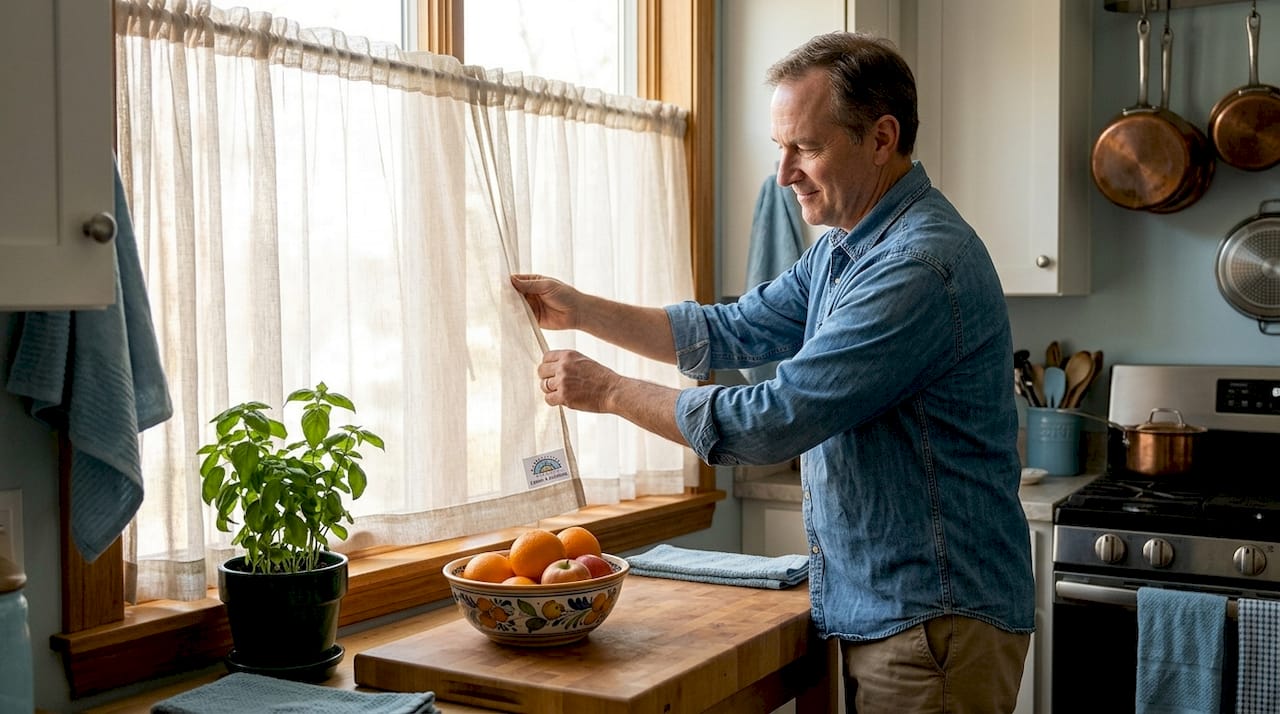
Blackout curtains can reduce solar heat gain, lowering the cooling load especially when used to block sun-exposed windows. Thermal blackout curtains fitted snugly to cover the full window opening can reduce incoming heat by as much as one-third during peak summer hours. That reduction translates directly into lower air conditioning use and measurable savings on utility bills over a season.
Steps to maximize summer energy savings with blackout curtains:
- Identify your high-exposure windows. South and west-facing windows collect the most heat. Prioritize these rooms first.
- Choose a curtain with proper thermal backing. A dense, multi-layer fabric structure performs far better than a single-ply option labeled “blackout.”
- Ensure full window coverage. Curtains should extend several inches beyond the window frame on all sides to prevent heat from creeping in around the edges.
- Close curtains before the sun hits. Closing them in the morning on south-facing windows and by early afternoon on west-facing ones keeps the room cooler without waiting for it to heat up first.
- Combine with other insulation measures. Pairing curtains with proper home insulation, as outlined in energy efficiency tips, creates a more complete thermal barrier throughout your home.
Exploring energy saving window treatments in detail gives you a broader picture of how different drapery styles and fabric weights interact with your home’s thermal performance across all seasons.
Pro Tip: Layer a sheer curtain underneath your blackout panel. This gives you the option to filter light softly during the day without sacrificing the thermal insulation the blackout layer provides when drawn.
Noise reduction and privacy: the unsung perks
Cooler rooms are great, but many families also need a quiet, private retreat. Here is how blackout curtains help with two needs that often go unaddressed in window treatment discussions.
Dense blackout fabrics absorb and dampen sound waves rather than reflecting them. This is particularly noticeable in rooms near busy streets, neighboring driveways, or urban noise sources. The effect is not dramatic in the way purpose-built acoustic panels work, but it is meaningful. A well-fitted floor-to-ceiling blackout curtain in a bedroom near a main road can soften the texture of outside noise enough to support undisturbed sleep.
Key privacy and noise benefits include:
- Daytime privacy without sacrificing a finished interior look, since the dense fabric blocks outside visibility even when interior lights are on
- Nighttime visibility protection, which matters especially for street-level rooms where interior lighting makes occupants visible through standard curtains
- Soft noise dampening that reduces the sharpness of traffic, wind, and neighborhood sound without structural renovation
- Routine protection, since families with young children benefit from knowing that interior movement and lighting are not visible to passersby during bedtime routines
“A key nuance is that blackout curtains are not always equivalent to ‘thermal curtains’ unless the product includes dense/thermal backing and is fitted to limit air leakage; the biggest energy gains are typically from the system, not the label alone.” — dotcomblinds.com
This point applies equally to noise control. The dense and well-fitted construction matters more than any product claim on the packaging. A loosely hung curtain with gaps at the sides allows both light and sound to enter. For practical guidance on selecting treatments room by room, the window treatment expert tips resource covers fit and function in useful detail.
Blackout vs. thermal vs. light-filtering curtains: what’s the difference?
These advantages stand out, but not all window treatments perform the same. Many homeowners use these terms interchangeably, which leads to purchases that disappoint. Here is a clear side-by-side comparison.
| Feature | Blackout curtains | Thermal curtains | Light-filtering curtains |
|---|---|---|---|
| Light blockage | 99%+ | Varies (50-90%) | Low (diffuses only) |
| Insulation value | Moderate to high | High | Low |
| Noise dampening | Moderate | Moderate | Minimal |
| Privacy level | High | Moderate to high | Low |
| Best use | Bedrooms, nurseries, media rooms | Living areas, cold climates | Common areas, offices |
| Style range | Wide | Moderate | Wide |
As noted, blackout curtains are not always equivalent to thermal curtains unless the product includes dense or thermal backing and a well-fitted installation. A curtain labeled thermal but made of a lightweight fabric with loose side gaps delivers poor insulation in practice.
When to choose each type based on your goals:
- Choose blackout curtains when sleep quality, melatonin support, or media room darkness are the primary priorities.
- Choose thermal curtains when winter insulation is the main concern, particularly in rooms with older or drafty window frames.
- Choose light-filtering curtains in living rooms, dining spaces, or home offices where you want to soften natural light without eliminating it.
- Layer both for the most versatile result: a blackout panel behind a light-filtering sheer gives you full control across the day.
For a regional perspective, the guide to window treatment types covers how climate and home style influence these decisions, which is especially relevant for homeowners in warmer, high-sun areas.
Blackout curtains in practice: choosing, fitting, and maximizing results
Understanding the differences helps, but how you choose and use blackout curtains is just as important as which ones you buy. Installation decisions account for a significant portion of real-world performance.
Fitting and installation checklist:
- Mount the rod high and wide. Position the curtain rod 4 to 6 inches above the window frame and extend it 6 to 8 inches beyond the frame on each side. This reduces light bleed at the edges.
- Choose floor-length panels. Curtains that reach the floor close off the gap at the bottom that would otherwise let light pool in under the hem.
- Overlap panels at the center. For two-panel setups, ensure the panels overlap by at least 2 to 3 inches at the center to eliminate a center gap.
- Check for wall-to-fabric contact on the sides. In rooms that require near-total darkness, consider a curtain track that allows the fabric to press closer to the wall surface.
- Select fabric weight appropriate to your climate. Heavier, denser fabrics perform better in both heat reduction and noise dampening.
| Fabric type | Typical light blockage | Best season use | Noise dampening |
|---|---|---|---|
| Triple-weave blackout | 99%+ | Year-round | Moderate |
| Foam-backed blackout | 95-99% | Summer/sun-heavy | Low to moderate |
| Single-weave blackout | 85-95% | Year-round | Low |
| Lined standard curtain | 60-80% | Mild climates | Minimal |
It is also worth noting that blackout curtains improve the sleep environment but will not resolve insomnia or circadian rhythm issues on their own. They work best as part of a broader routine that includes consistent sleep and wake times, limited screen use before bed, and a cool room temperature. Treating them as one element of a well-designed sleep environment, rather than a single cure-all, sets realistic and achievable expectations.
For fabric selection guidance that goes beyond the label, fabric tips for blackout curtains provides practical direction on weave density, backing materials, and care considerations.
Why the right system matters more than just the blackout label
One observation stands out after years of working with homeowners on window treatment projects: the label matters far less than the system. Homeowners often invest in a product marked “premium blackout” and are then disappointed when light still bleeds in along the sides, or when summer rooms stay stubbornly warm. The product itself may be fine. The installation and the fit are frequently where the results fall short.
A moderately priced curtain mounted correctly, covering the full window with adequate overlap, will outperform an expensive panel hung too narrow and too low. This is a point most product-focused articles overlook, because the answer is not about buying up, it is about fitting well.
The same logic applies to sleep benefits. A well-fitted blackout curtain used consistently as part of a structured sleep routine delivers measurable results. The same curtain left open because the room feels too closed-in provides almost none of those benefits. The behavior around the treatment matters as much as the treatment itself.
There is also a tendency to overestimate what any single product can do. Dense, high-quality blackout curtains genuinely support home comfort and well-being in ways that are well-documented. But they are not a substitute for proper insulation, a good sleep routine, or structural soundproofing when those are the real issues. The homeowners who see the best results treat window treatments as one well-chosen component of a larger system, not a standalone fix.
The most practical advice is this: measure carefully, mount high and wide, choose a dense fabric with a quality backing, and use the curtains consistently. That combination almost always delivers the comfort, energy savings, and sleep improvement that brings homeowners to blackout curtains in the first place.
Ready to upgrade your window treatments?
Putting these advantages into practice starts with the right fabric and a treatment designed to fit your windows precisely.
At Beautiful Windows Elgin, you will find a curated selection of premium fabrics suited for custom blackout drapery, from dense triple-weave textiles to refined lined panels that combine light control with an elegant finished look. Whether you are outfitting a master bedroom, a nursery, or a sun-heavy living area, the selection is designed to meet both performance and aesthetic standards. Explore options including durable upholstery fabrics for coordinating interior projects, and take advantage of design consultation services to ensure every treatment fits and performs as intended. Nationwide shipping and expert guidance make it easy to start your project with confidence.
Frequently asked questions
Do blackout curtains save money on energy bills?
Yes, blackout curtains reduce solar heat gain by up to 33%, which often produces noticeable reductions in cooling costs during summer months, particularly in south and west-facing rooms.
Are blackout curtains safe for children’s rooms?
Yes, blackout curtains are a popular and effective choice for nurseries because they support melatonin regulation and help babies sleep during daylight hours, though cordless or rod-pocket styles are strongly recommended for child safety.
Can blackout curtains completely stop noise?
No, blackout curtains reduce outside noise but will not fully soundproof a room. Dense, well-fitted curtains deliver the most noticeable noise dampening, though dedicated acoustic solutions are needed for significant sound control.
What’s the downside to blackout curtains?
Some homeowners find that full light blockage feels too isolating, or they miss natural light in the morning. Layering a light-filtering sheer beneath the blackout panel gives you flexible control without committing to complete darkness at all hours.
How do I maximize blackout curtain benefits?
Mount the rod 4 to 6 inches above the window frame, extend it 6 to 8 inches beyond the frame on each side, and choose floor-length panels that overlap at the center. This installation approach eliminates the edge gaps where most light actually enters.
Recommended
- Top benefits of blackout lining for custom window treatments – Fabric Store in Columbia, SC | Drapery Making Services
- 5 key benefits of custom drapes for beautiful spaces – Fabric Store in Columbia, SC | Drapery Making Services
- What is blackout fabric? Benefits, uses, and DIY tips – Fabric Store in Columbia, SC | Drapery Making Services
- Curtain lining: cut heat loss 40% and boost style – Fabric Store in Columbia, SC | Drapery Making Services