
Curtain lining: cut heat loss 40% and boost style
TL;DR:Curtain linings can reduce home heat loss by up to 40% and lower energy bills.Properly installed linings enhance insulation, light control, noise reduction, and fabric longevity.Choosing the right lining type and installation details maximizes comfort, energy savings, and curtain durability.
Curtain linings can reduce home heat loss by up to 40%, yet most homeowners treat them as an afterthought. That gap between perception and reality costs real money every month. A well-lined curtain does far more than look polished; it actively manages temperature, light, noise, and the long-term condition of your fabric investment. Thermal linings reduce heat loss 15-40% and can trim energy bills by 10-25%. This article walks you through the types of curtain linings available, the measurable benefits each delivers, and practical guidance for getting the most out of every window in your home.
Table of Contents
- Why curtain lining matters: More than just looks
- Insulation, energy, and comfort: The science behind curtain lining
- Light control and privacy: Blackout and specialty linings
- Noise reduction and durability: Beyond temperature and light
- What most homeowners overlook about curtain lining
- Upgrade your home with premium curtain linings
- Frequently asked questions
Key Takeaways
| Point | Details |
|---|---|
| Insulation advantage | Curtain linings can cut heat loss by up to 40%, saving on energy bills. |
| Light and privacy | Blackout linings ensure privacy and darken rooms for restful sleep. |
| Noise reduction | Quality linings reduce household noise by as much as 12 decibels. |
| Longevity boost | Lining protects curtain fabric from sun, wear, and fading for long-lasting results. |
| Practical investment | Smart lining choices pay off in comfort, performance, and future savings. |
Why curtain lining matters: More than just looks
A curtain lining is a secondary layer of fabric sewn or attached to the back of your main curtain panel. It sits between the decorative face fabric and the window, creating a buffer zone that serves several functional purposes at once. Most people assume lining is reserved for formal rooms or high-end custom work, but that assumption leaves a lot of value on the table.
The most persistent myth is that lining is purely cosmetic, added only to give curtains a fuller drape or a neater appearance from the street. In reality, lining actively changes how your room performs. It reduces drafts, slows heat transfer, protects the face fabric from UV degradation, and adds acoustic mass to a room. These are measurable, practical gains that affect daily comfort and monthly costs.
Here is what curtain lining actually does for your home:
- Thermal regulation: Creates an insulating air pocket between the glass and the room
- UV protection: Shields face fabric from fading and fiber breakdown caused by direct sunlight
- Structural support: Adds body to lightweight fabrics, improving drape and hang
- Acoustic dampening: Adds mass that absorbs and deflects sound waves
- Privacy enhancement: Reduces visibility from outside, especially at night
- Longevity: Extends the usable life of your curtains by years
“Thermal linings reduce heat loss by 15-40% and can deliver energy savings of 10-25% on heating and cooling bills, depending on installation quality and coverage.” Insulated Curtains That Actually Work: Empirical Benchmarks
Understanding about drapery lining helps clarify which material suits each room’s specific needs. Whether you are working with sheer voile in a sunroom or heavy jacquard in a formal dining room, the lining choice shapes the final result as much as the face fabric does. You can also explore the broader benefits of custom drapes to see how lining fits into a complete window treatment strategy.
The takeaway here is straightforward. Lining is not a luxury add-on. It is a functional component that determines how well your curtains actually work in the real world.
Insulation, energy, and comfort: The science behind curtain lining
When cold air meets a warm room, heat moves toward the cold surface. Windows are among the weakest points in any home’s thermal envelope, and unlined curtains do very little to slow that transfer. A lined curtain introduces an air gap and a denser material barrier, both of which slow conductive and convective heat loss significantly.
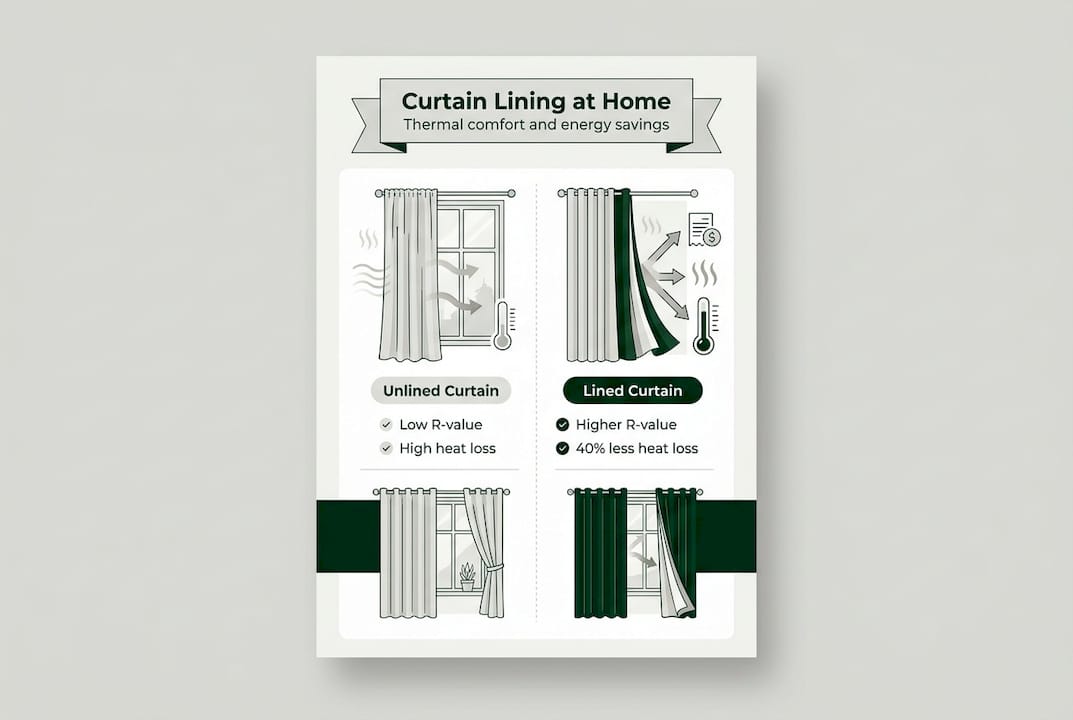
The measure used to quantify this resistance is the R-value. A higher R-value means better insulation. Standard unlined curtains offer minimal resistance, often below R-1. Thermal linings push that number considerably higher, and layered systems can reach meaningful levels for a window treatment.
| Lining type | Approximate R-value | Heat loss reduction | Energy bill impact |
|---|---|---|---|
| Unlined curtain | Below R-1 | Minimal | Negligible |
| Standard lining | R-1 to R-2 | 10-15% | Moderate |
| Thermal lining | Up to R-6 | 15-40% | 10-25% savings |
| Layered system | R-1.5 to R-4 | 20-35% | 15-22% savings |
These figures come from empirical benchmarks on insulated curtains, which confirm that thermal linings with proper installation consistently outperform unlined alternatives across all climate types. The difference is most pronounced in rooms with large windows or older single-pane glass.
For homeowners considering an upgrade, the custom curtain benefits page offers useful context on how lining selection integrates with fabric weight and window size. Reviewing available window treatment types also helps you match the right lining to the right application.
Pro Tip: For maximum thermal performance, hang curtains so they overlap the window frame by at least two inches on each side and reach the floor. Gaps at the edges and bottom allow cold air to bypass the lining entirely, reducing its effectiveness by a significant margin.
The comfort gain is not just about temperature numbers. Rooms with properly lined curtains feel warmer in winter and cooler in summer because radiant chill from the glass is blocked before it reaches occupants. That qualitative improvement is often what homeowners notice first.

Light control and privacy: Blackout and specialty linings
Managing light is one of the most immediate reasons homeowners seek out specialty linings. Standard lining reduces glare and softens incoming light, but blackout lining takes that control to a different level entirely. It is woven or coated to block virtually all light transmission, making it the preferred choice for bedrooms, media rooms, and nurseries.
Blackout linings block 90-100% of light, but achieving true darkness depends on installation precision, not just the fabric itself. A blackout panel with gaps at the sides or top will still allow light to bleed in around the edges, defeating the purpose.
For reliable results, follow these installation guidelines:
- Measure generously: Cut panels wide enough to overlap the window frame by at least two to three inches on each side
- Extend above the frame: Mount the rod four to six inches above the window to prevent light from entering at the top
- Check the hem: The panel should reach the floor or windowsill without a gap
- Use a center overlap: For two-panel setups, ensure the panels overlap at the center by at least two inches
- Inspect for pinholes: Some blackout fabrics develop small holes over time; check periodically and replace as needed
Pro Tip: If you are sewing your own blackout curtains, use a triple-pass blackout lining rather than a single-pass coating. Triple-pass materials are more durable, resist cracking with repeated washing, and maintain their light-blocking performance longer.
Privacy linings serve a related but distinct purpose. They reduce visibility from outside without eliminating natural light entirely, making them well suited for street-facing rooms where you want daylight but not an audience. You can read more about blackout fabric benefits to compare options before committing to a material.
For ready-made solutions, the linen blackout curtain panels offer a refined linen appearance with full blackout performance, while the [stone blackout panels](https://www.beautifulwindowselgin.com/products/midorii-stone-100-blackout curtain-panel-rod-pocket-with-header-3inche-rod-pocket-2inche-header-47inches-wide-100-polyester-panel-sold-individual) provide a clean, neutral finish suited to contemporary interiors.
Noise reduction and durability: Beyond temperature and light
Curtain linings also address a comfort factor that often goes unnoticed until it is gone: household noise. A lined curtain adds mass and density to your window treatment, and mass is what absorbs and deflects sound. The reduction is not dramatic enough to replace acoustic panels in a recording studio, but it makes a genuine difference in everyday living spaces.
| Lining type | Approximate noise reduction | Best application |
|---|---|---|
| Standard lining | 3-5 dB | General living areas |
| Thermal lining | 5-8 dB | Bedrooms, home offices |
| Blackout lining | 6-10 dB | Street-facing rooms |
| Layered system | 8-12 dB | High-traffic or urban settings |
Noise reduction ranges from 3 to 12 decibels depending on lining type and installation. To put that in perspective, a 10 dB reduction cuts perceived loudness roughly in half. For a bedroom facing a busy street, that difference is the gap between restful sleep and a disrupted night.
Durability is the other underappreciated benefit. Here is how lining extends the life of your curtains:
- UV blocking: Lining absorbs the majority of solar radiation before it reaches the face fabric, slowing color fading and fiber degradation
- Moisture buffering: Lining reduces condensation contact on the face fabric in cold climates
- Structural reinforcement: Lining stabilizes lightweight or loosely woven fabrics, preventing stretching and distortion over time
- Soil protection: Lining keeps the back of the face fabric cleaner, reducing how often the entire curtain needs laundering
The U.S. Department of Energy notes that drapes cut solar gain by 33% when properly installed, which directly reduces the thermal stress placed on both the fabric and the room.
For homeowners investing in quality face fabrics, exploring stylish curtain fabrics alongside lining options ensures the two layers work together effectively. Reviewing curtain fabric types helps match fabric weight and weave to the appropriate lining density.
What most homeowners overlook about curtain lining
Most people think about curtain lining at the end of a window treatment project, almost as a finishing detail. That timing is one of the most common and costly mistakes in home decorating. Lining decisions shape every functional outcome: how warm the room feels, how well you sleep, how long the curtains last, and how much your energy bills reflect the investment.
The small details matter more than most realize. Overlapping the window frame by two inches on each side, choosing a triple-pass blackout over a single-pass coating, or selecting thermal lining for a north-facing bedroom rather than a standard cotton backing. These are not premium upgrades for luxury homes. They are practical choices that pay back their cost in comfort and savings within a single season.
Lining also future-proofs your window treatments. A room that is comfortable today may face different demands as energy costs rise or household needs change. Choosing the right lining now means you will not be replacing curtains in three years because they faded, sagged, or failed to perform. Explore custom curtain choices to see how these decisions come together in a complete, well-considered window treatment.
Upgrade your home with premium curtain linings
The functional gains from quality curtain lining are clear, and the right materials make all the difference in achieving them. At Beautiful Window Elgin, you will find a curated selection of fabrics and window treatment solutions designed to deliver both performance and refined style.

For projects requiring durable, weather-resistant material, the waterproof canvas fabric offers a reliable foundation for specialty applications. For a broader selection of quality textiles suited to every room and lining need, browse the full range of designer fabrics by the yard available through the site. Whether you are sourcing lining fabric for a single panel or outfitting an entire home, the selection and expertise at Beautiful Window Elgin supports every step of the process.
Frequently asked questions
How much can curtain lining reduce my energy bills?
Thermal linings cut energy bills by 10-25% depending on coverage and installation quality. Proper overlap and full-length panels maximize those savings.
Are blackout linings effective for complete darkness?
Blackout linings block 90-100% of light, but true darkness requires full overlap at the sides, top, and center of the window to eliminate all gaps.
Which curtain linings are best for noise reduction?
Thicker lining materials reduce noise by 3-12 decibels depending on type, with layered systems offering the greatest acoustic improvement for urban or high-traffic settings.
Can curtain lining help protect curtains from sun damage?
Lining acts as a barrier that absorbs solar radiation before it reaches the face fabric, and the DOE confirms drapes reduce solar gain by 33%, directly extending curtain lifespan.
Recommended
- What is drapery lining and why it matters for your home – Fabric Store in Columbia, SC | Drapery Making Services
- Trending curtain fabrics for stylish windows in 2026 – Fabric Store in Columbia, SC | Drapery Making Services
- Fall Window Treatment Trends 2025: Warmth, Texture Tailored Elegance – Shop Designer Fabrics by the Yard | Curtains & Drapery
- Fall Window Treatment Trends 2025: Warmth, Texture Tailored Elegance – Shop Designer Fabrics by the Yard | Curtains & Drapery