
Marine Vinyl Thickness: Mil, Gauge and mm Explained
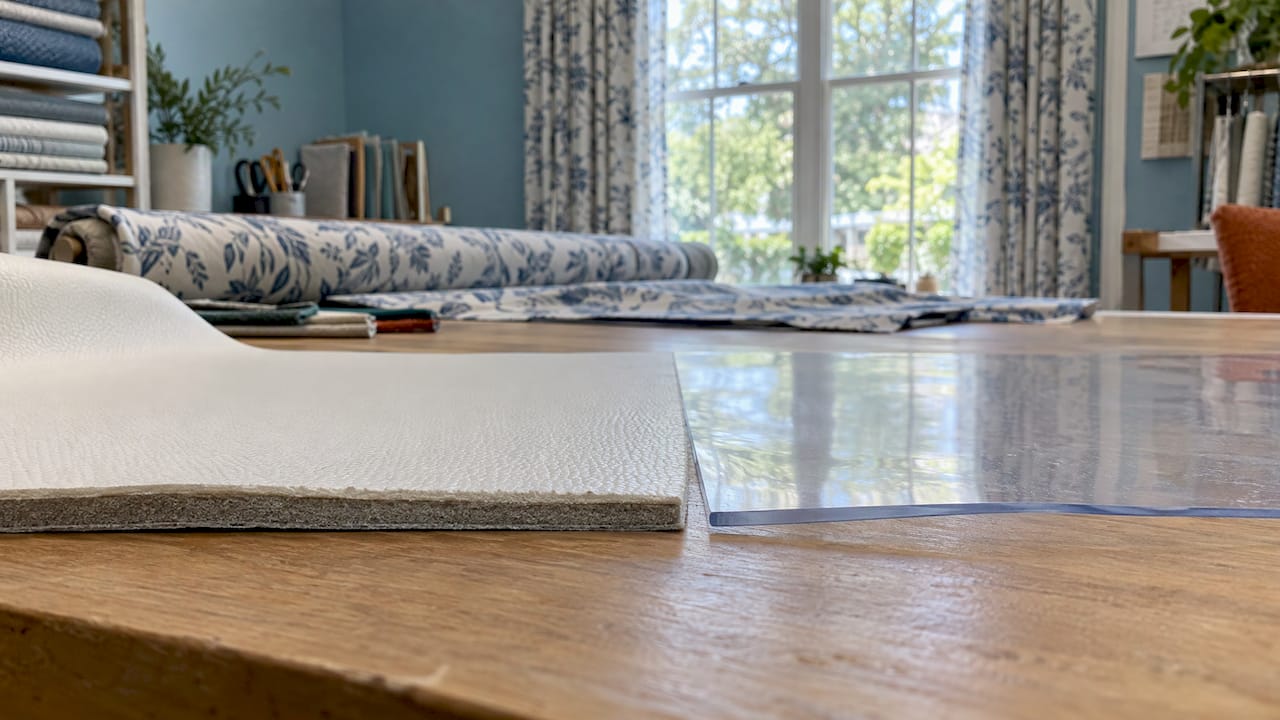
Marine vinyl thickness is quoted three ways: millimeters, inches (or thousandths of an inch) and gauge. Solid-color upholstery vinyl for seats and cushions is usually listed at roughly 0.85 to 1.0 mm, while clear vinyl for boat windows is sold by gauge, most often 30 or 40. Thickness matters, but it is only one of several specifications that decide whether a vinyl survives sun, salt and cold. This guide shows how to read each number, which thickness suits which job, and what to check beside it before you order yardage.
BeautifulwindowselginFind Fabric for Your Marine ProjectExplore marine and utility fabrics alongside upholstery textiles, with personalized guidance for choosing materials that suit your project.Visit
TL;DR
- Upholstery vinyl for seats, cushions and bolsters is typically listed at around 0.85 to 1.0 mm. Clear window vinyl is listed by gauge, commonly 30 to 40.
- Gauge in clear vinyl is generally read as thousandths of an inch, so 30 gauge is about 0.030 in, or 0.76 mm, and 40 gauge is about 0.040 in, or 1.02 mm.
- Thicker clear vinyl tends to last longer and look clearer, but it is stiffer, especially in cold weather, and costs more.
- Thickness alone does not make vinyl marine grade. Abrasion, UV aging, cold-crack and mildew ratings matter as much.
- Our team can help you match a marine or utility fabric to your project and your sewing method.
Table of Contents
- How marine vinyl thickness is measured
- Thickness of upholstery vinyl versus clear vinyl
- Matching thickness to the project
- Roll width and length
- What else decides whether vinyl is marine grade
- Is thicker vinyl more waterproof?
- Choosing marine and utility fabric with us
- FAQ
- Sources
How marine vinyl thickness is measured
The industry measures thickness of coated fabric with a deadweight gauge, a small presser-foot instrument that reads to 0.001 inch (0.025 mm), according to the Coated Fabrics and Film technical pamphlet from the Coated Fabrics and Film Association. That is why you will see so many figures that end in a small decimal: 0.035 in, 0.9 mm, 0.97 mm. They are readings from the same kind of measurement, expressed in different units.
The three units you will meet:
- Millimeters. Common on upholstery vinyl listings. Easy to compare across products.
- Inches or mils. One mil is one thousandth of an inch. A vinyl listed at 0.035 in is 35 mils, about 0.89 mm.
- Gauge. Used mostly for clear vinyl. In practice, gauge is read as thousandths of an inch, so 30 gauge is about 0.030 in.
A quick conversion table
Multiply inches by 25.4 to get millimeters. The figures below are rounded.
| Gauge or mils | Inches | Millimeters | Typical use |
|---|---|---|---|
| 20 | 0.020 | 0.51 | Lightweight clear covers, protective sheeting |
| 30 | 0.030 | 0.76 | Clear windows that roll up often, table covers |
| 35 | 0.035 | 0.89 | Close to the range of many upholstery vinyls |
| 40 | 0.040 | 1.02 | Forward and fixed clear windows, enclosures |
| 60 | 0.060 | 1.52 | Heavy clear sheet, flat panels |
Flexible marine windows are typically made from clear vinyl between 0.020 and 0.060 inch, according to a marine canvas care guide, which is the span the table covers.
Thickness of upholstery vinyl versus clear vinyl
The first confusion is that two very different products share the name marine vinyl.
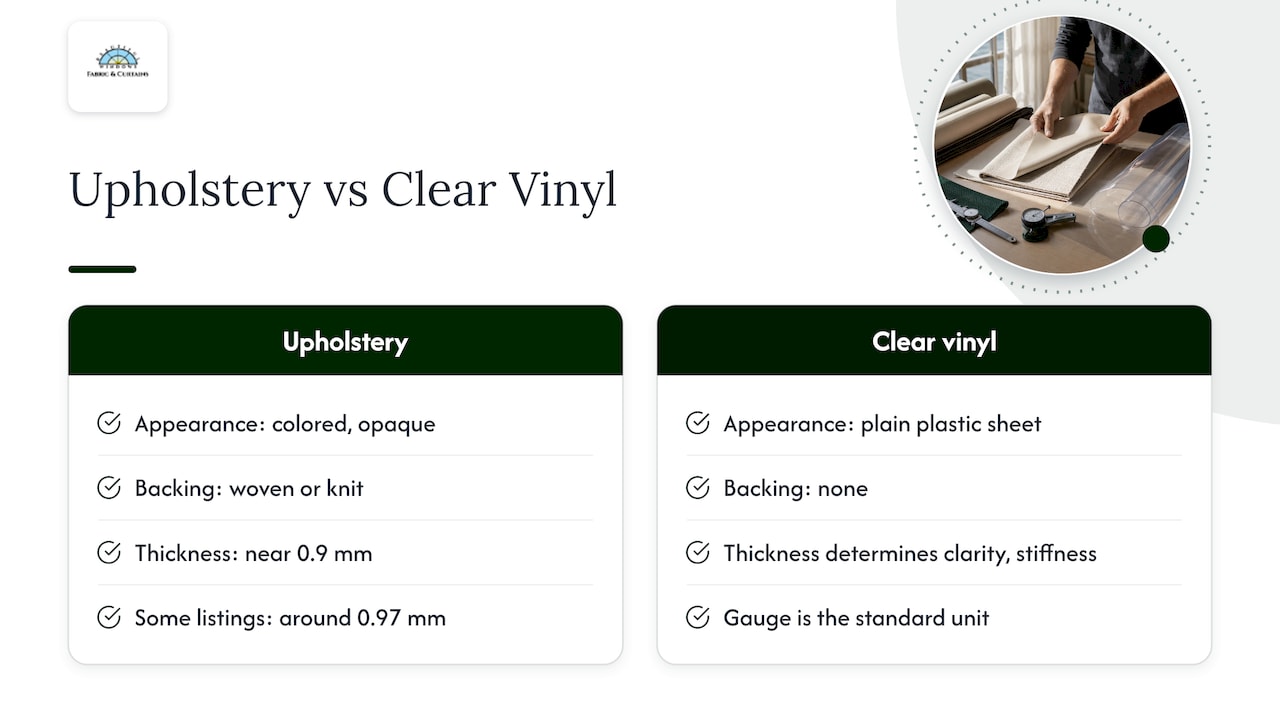
Upholstery vinyl is a colored, opaque PVC coating on a woven or knit backing. Product listings for marine upholstery vinyl commonly state a thickness near 0.9 mm, and some list around 0.97 mm. Weight is often quoted too: a standard heavy-duty yacht upholstery vinyl is often described as about 28 oz per linear yard in a 54-inch width. Because the backing fabric carries a share of the strength, the vinyl layer itself is thin, yet the finished material is firm and durable.
Clear vinyl has no backing. It is a plain plastic sheet, so its thickness is the whole story: it determines clarity, stiffness and how well it holds up over seasons. This is where gauge is the standard unit.
If you are comparing a listing in millimeters to another in gauge, convert both to millimeters first. Do not compare gauge on clear vinyl to the thickness of upholstery vinyl, because they do different jobs.
Matching thickness to the project
Seats, cushions and bolsters
For upholstery, a thickness around 0.9 mm is the common reference point. Past a certain point, extra thickness stops helping. A thin coating on a strong backing wraps tight corners and sews cleanly, while an overly stiff material resists curves and stresses seams. For seating, weight per yard, backing and finish tell you more than a fraction of a millimeter does.
Our Marine Fabric Checklist walks through the other points to confirm when choosing boat upholstery, and our guide to types of marine fabrics explains where vinyl sits next to other options.
Boat windows and enclosures
Clear vinyl is where gauge choices count. Thicker material is more optically true and lasts longer, but it is stiffer, harder to roll in cold weather and costs more. Marine Fabricator reported one canvas shop’s rule of thumb: 40 gauge for forward windows, which stay put, and 30 gauge for side and aft windows, which are rolled up more often and need to be more malleable. The same article notes that thicker gauges often extend a window’s lifespan, and that labor can cost far more than the material, so a cheap, short-lived sheet can be the more expensive choice.
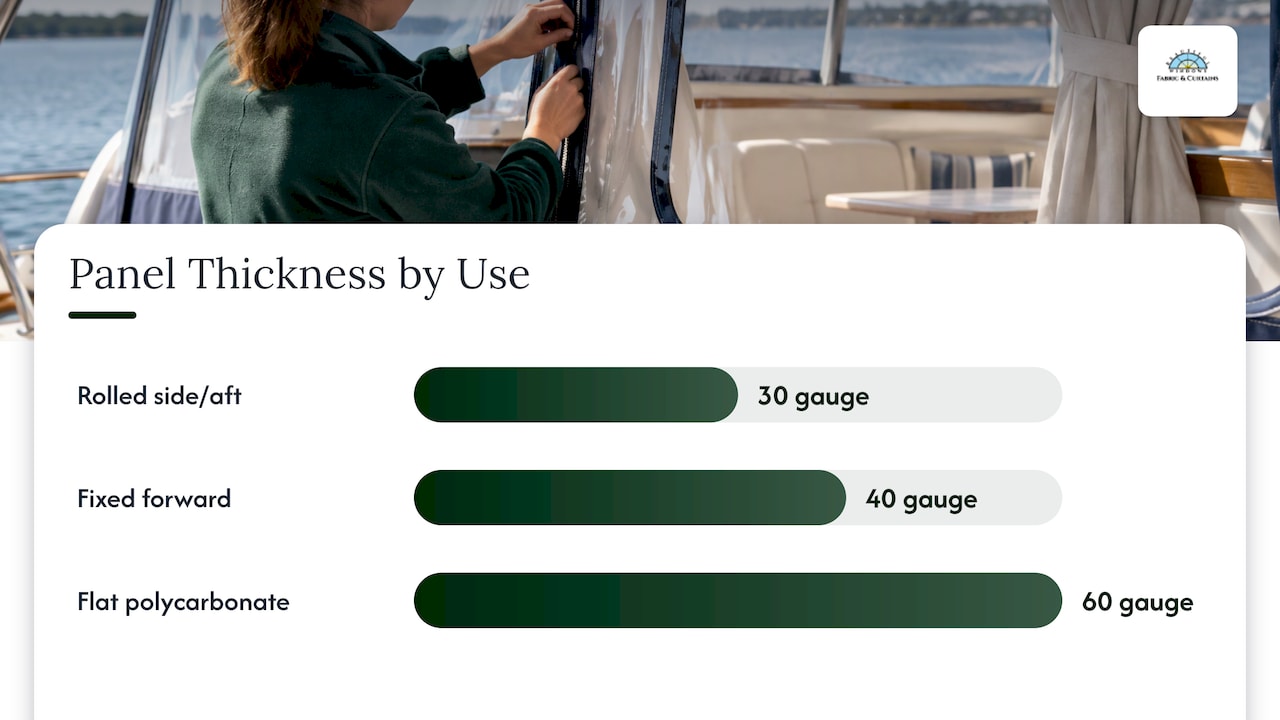
PassageMaker describes a similar approach: 40 gauge clear vinyl for enclosures because it holds its shape yet is flexible enough to unzip and roll, supplied in 54 by 110 inch sheets that allow wide panels with fewer zippers joining them. For flat panels that face wide temperature swings, it points to 60 gauge polycarbonate, a different material altogether.
A practical way to read this:
- Decide whether the panel will be rolled often or stay fixed.
- Choose 30 gauge for panels you roll and 40 gauge for panels that stay in place.
- Move up in thickness only when the panel is large and needs to resist flexing.
Roll width and length
Thickness is not tied to roll size. Marine upholstery vinyl is commonly sold at 54 inches wide, and shops sell it by the yard from a bolt, with full rolls often running to many yards. Clear vinyl is also commonly sold at 54 inches wide and 10-yard or longer lengths, and listings state the gauge separately. When you plan a project, measure the widest panel you need first. A 54-inch width means a seat back wider than that needs a seam, while a wide clear panel may call for a sheet size that avoids a joining zipper.
Buy a little extra when you are matching a pattern or sewing curved panels. Cutting waste on a boat cushion is higher than most first-time buyers expect.

BeautifulwindowselginExplore Fabrics for Your Project106 Barney Lane, 29223 Richland CountyGet directions© OpenStreetMap contributors
What else decides whether vinyl is marine grade
A vinyl can be thick and still fail in a season. The Coated Fabrics and Film Association publishes recommended minimum performance standards for marine vinyl-coated upholstery, and it sets minimums for several properties:
- Abrasion resistance of 25,000 cycles
- 650 hours of QUV light aging, which simulates sunlight exposure
- Cold-crack resistance at 10°F
- Mildew resistance
- Pink-stain resistance
The same document recommends mildew treatment for every element of a fabrication, since leakage through sewn seams or wicking in the backing can lead to fungal growth and eventual failure. In other words, a waterproof coating is not the whole answer: seams, thread and backing all play a part.
For clear vinyl, Specialty Fabrics Review lists the factors to weigh as clarity, scratch resistance, UV resistance, stain and chemical resistance, flexibility and cost. It identifies UV exposure as the leading cause of clear vinyl failure, because sunlight drives out the plasticizers that keep the sheet supple, leaving it brittle, cloudy and eventually cracked. Coatings help lock those plasticizers in. The same article explains that press-polished vinyl, made by pressing two heated layers between polished plates, gives excellent clarity and dimensional stability, while extruded vinyl is cheaper and more prone to scratching.
A short checklist for a vinyl order
- Thickness in the unit you are comparing, converted to millimeters
- Weight per linear yard and width
- Backing type for upholstery vinyl
- UV, cold-crack, abrasion and mildew ratings
- Whether the vinyl is made for indoor, outdoor or marine use
- Yardage including cutting waste
Is thicker vinyl more waterproof?
Not by itself. Vinyl coating is waterproof at any normal thickness. Water problems on a boat come from seams, stitch holes, edges and the backing, not from the face of the vinyl. That is why the performance standard above focuses on mildew treatment and construction. Choose thickness for feel, forming and durability, and look to sewing technique and thread for water resistance.
Our view on vinyl thickness
Buyers often ask us for the thickest vinyl available, as if thickness were a score. In our experience of selling marine and utility fabric, the better question is what the material has to do. A cushion needs a vinyl that wraps corners and sews cleanly. A boat window needs clarity and the right flexibility. A utility cover needs a fabric that holds up under repeated handling.
We curate our marine textile and upholstery vinyl selection so a buyer can compare fabrics by use, and we offer fabric samples so you can judge the hand and weight of a material before committing to yardage. Because we also run a custom drapery service with design consultations and installation guidance, we think in terms of whole projects: width, seams, cut layout and how the finished piece will be used.
If you are unsure which weight suits your project, talk to us before you cut. A short conversation about the application usually settles the question faster than a spec sheet.
Marrion
Choosing marine and utility fabric with us
We sell marine textile and utility fabric by the yard, along with upholstery fabric, with nationwide shipping, and our team can support design consultations and fabric samples for your project. For a vinyl-faced option, see our Dark Truffle vinyl upholstery fabric, sold by the yard, or browse the full range on our fabric store home page.
If your project is a boat cover or cushion set, our DIY boat cover workflow covers the steps, and the comparison of marine vinyl and canvas helps you choose the right face fabric. Drapery workrooms and upholsterers who need larger quantities can see our wholesale fabric range through the same store.
FAQ
How thick is 30 gauge vinyl in inches?
Thirty gauge clear vinyl is generally read as 0.030 inch, which is about 0.76 mm. Forty gauge is about 0.040 inch, or 1.02 mm. Always confirm the unit on the product page, since upholstery vinyl is listed in millimeters.
How thick should marine upholstery vinyl be?
Most marine upholstery vinyl is listed at roughly 0.85 to 1.0 mm, often with a weight near 28 oz per linear yard. At this range, the material is strong enough for seating and flexible enough to wrap and sew. Backing, finish and UV and mildew treatment matter as much as the number.
Is thicker clear vinyl always better for boat windows?
Thicker clear vinyl is more optically true and tends to last longer, but it is stiffer and harder to roll in cold weather. Many fabricators pair 40 gauge for fixed forward windows with 30 gauge for windows that roll up. Match the gauge to how the panel will be used.
Is marine vinyl waterproof?
The coated surface is waterproof, but leaks and mildew come through seams, stitch holes and the backing. Industry guidance recommends mildew treatment on all components and careful seam construction. Thickness does not change this.
What width does marine vinyl come in?
Marine upholstery vinyl and clear vinyl are both commonly sold 54 inches wide. Width is separate from thickness, so check both on the listing and plan seams for any panel wider than the roll.
BBeautifulwindowselginDiscuss Your Marine Fabric NeedsReach out to discuss marine or utility fabric options and get personalized guidance for your project and sewing method.+1 8032434383+1 8038652935info@beautifulwindowselgin.com
Sources
- Coated Fabrics and Film technical pamphlet
- Recommended minimum performance standards for vinyl-coated marine upholstery
- Marine canvas care guide
- Dynamic window materials, Marine Fabricator
- Boat Canvas and Enclosures, PassageMaker
- Fabricators and boat owners have a world of choices in windows, Specialty Fabrics Review