
Soil Release Fabric: What It Is and How to Choose It for Curtains

Soil release fabric is fabric treated so that dirt, oils and stains come out more easily when it is cleaned. It is not the same as a fabric that refuses to get stained. For curtains, drapery and upholstery, that difference decides which fabric suits a busy kitchen, a family room or a boat cockpit. At Beautiful Windows Elgin in Columbia, SC, we sell stain-resistant fabrics by the yard, ready-made curtain panels and custom drapery, so you can choose the right fabric and have it made up in the same place.
BeautifulwindowselginChoose Curtains That Clean Up EasierExplore fabrics by the yard, ready-made curtain panels, and custom drapery to find an option suited to your window treatment project.Visit
TL;DR
- A soil release finish helps stains leave the fabric during cleaning. It does not stop a liquid from soaking in.
- Stain repellent finishes make liquids bead up. Soil release finishes help the stain wash out. Many fabrics combine both.
- Open, loosely constructed curtain fabrics and fabrics made of synthetic fibers pick up airborne soil more readily, so construction matters as much as the finish.
- Check the label for the type of finish, the cleaning method, and performance data such as colorfastness and lightfastness before you buy.
- Even a treated fabric needs prompt, recommended cleaning, and no harsher chemicals than the care instructions allow.
Table of Contents
- What soil release fabric means
- Soil release, stain repellent and stain resistant: the differences
- Which fabrics and soils it is designed for
- How well it works on curtains and drapery
- What to check before you buy
- Caring for soil-release curtains
- Fabrics we offer for easy-care projects
- Our view
- From fabric to finished curtains
- FAQ
- Sources
What soil release fabric means
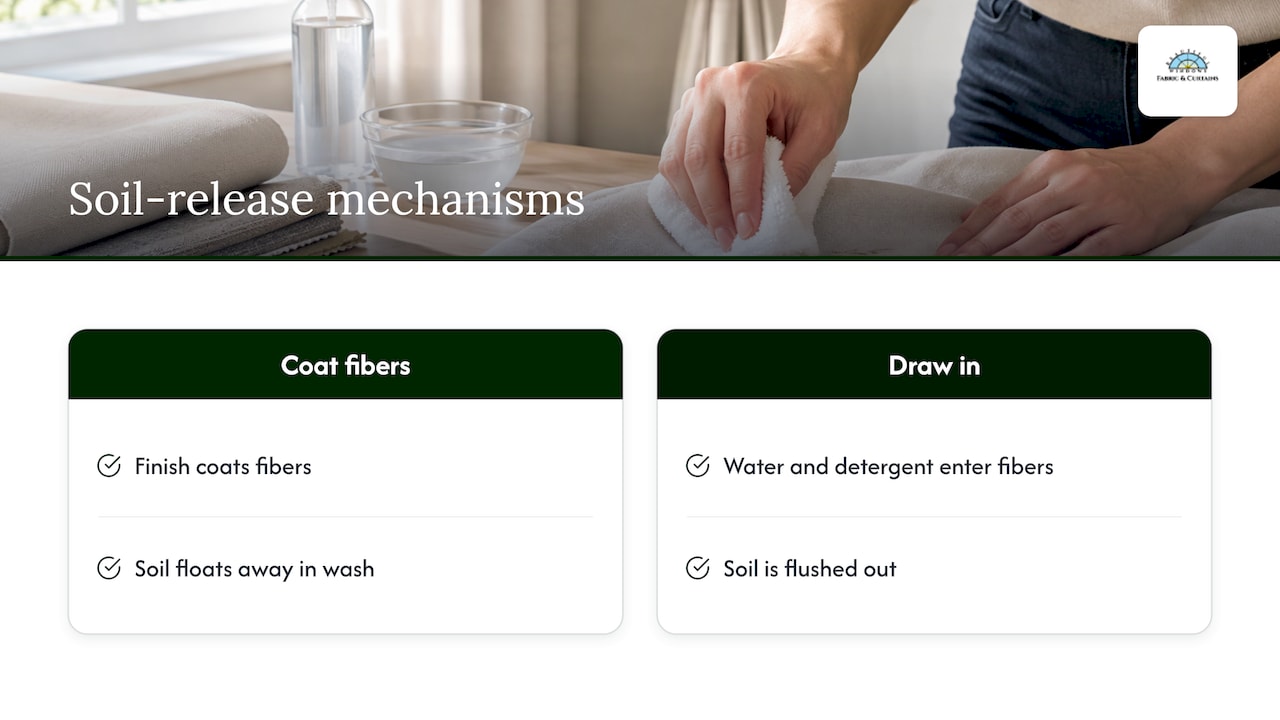
A soil-release property is the cleanability of a fabric through laundering. The finish is applied to the fabric at the mill, and its job is to let ordinary washing remove soil that would otherwise stay put. Textile science sources describe it as a finish that makes stains easier to remove, not one that prevents them.
There are two broad ways a finish does this. According to a University of Idaho extension document, some soil-release finishes coat the fibers so soil floats away in the wash. Others attract water and detergent into the fibers so the soil is flushed out. The same document notes that durable press finishes reduce a fabric’s absorbency, which is why a separate soil-release treatment is often added to those blends.
Finish chemistry in plain terms
Cotton Incorporated’s technical bulletin on functional finishes for cotton describes the main families:
- Fluorochemical soil release repels stains somewhat, though less than finishes made for strong water and oil repellency. It is normally applied together with the durable press finish.
- Acrylic polymer soil release gives good release but no repellency, and the fabric can feel stiff until after a wash.
- Blends of the two give strong release plus some repellency.
- Dual-action finishes give more stain resistance than traditional soil release while still letting stains that do penetrate wash out more easily.
You do not need to know the chemistry to buy well. What matters is knowing that the finish type changes how the fabric behaves when something spills.
Soil release, stain repellent and stain resistant: the differences
These terms are used loosely in shops, and the confusion leads to disappointment. The Association for Contract Textiles explains them in its guide to stain repellent finishes:
| Term | What it means | What you see |
|---|---|---|
| Soil/stain release | The fabric lets go of dirt, oils and discoloration after cleaning | A spill may soak in, but it washes out more readily |
| Repellency | The fabric sheds liquid | Liquid beads up and rolls off |
| Resistance | The fabric withstands discoloration | Less staining from the start |
The Cotton Incorporated bulletin on repellent finishing adds that on a soil-release fabric liquids may not bead up but usually soak in, and that the AATCC 130 test is used to evaluate soil release. Repellency is measured separately, with AATCC 118 for oil repellency and a drop test for water repellency.
ACT also lists misconceptions worth keeping in mind: “bleach cleanable” means the fabric survives bleach, not that every stain disappears; a repellent finish does not mean any cleaner is safe; and repellents are not moisture barriers. The practical rule is to clean as the manufacturer recommends and use nothing harsher.
The University of Idaho document also advises reading the label, since some finishes repel water-based stains, some oily stains, and some both.

BeautifulwindowselginExplore Fabrics for Your CurtainsSee the fabric selection and discuss custom drapery services for window treatments suited to your home or project.Beautiful Windows Elgin106 Barney Lane, 29223 Richland CountyGet directions© OpenStreetMap contributors
Which fabrics and soils it is designed for
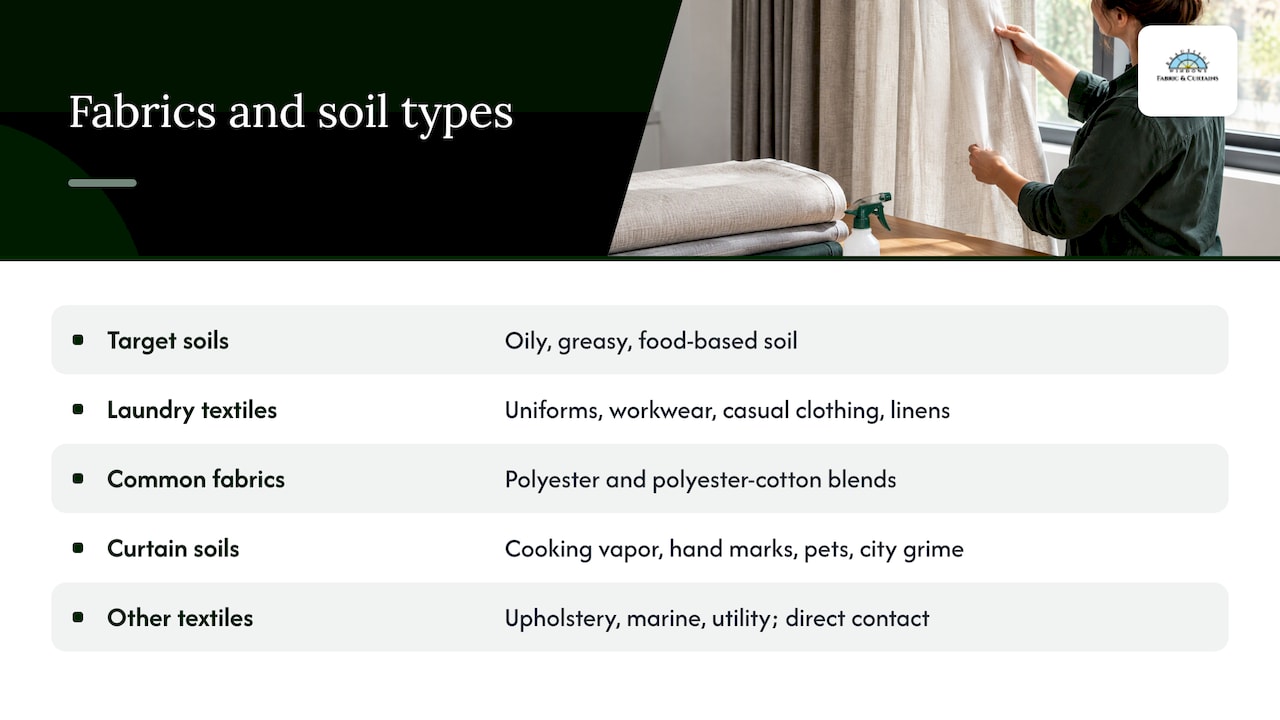
Soil release was developed for fabrics that get laundered and that meet oily, greasy or food-based soil: uniforms, workwear, casual clothing and table linens. The finish is widely applied to polyester and polyester-cotton blends, because durable press blends tend to hold oily stains. NAUMD’s terminology primer describes soil release as increasing the absorbency of durable press blends so stains leave faster and wick away for easier cleaning.
For home textiles the same logic applies in a different pattern. Curtains rarely meet a plate of spaghetti, but they do meet cooking vapor, hand marks on the leading edge, pet contact, dust and city grime. Upholstery and marine or utility fabrics meet far more direct contact, so a finish that eases cleaning pays off more there.
How well it works on curtains and drapery
A finish is only part of the picture. University of Florida Extension’s publication on soiling of draperies and curtains makes three points useful to anyone choosing fabric:
- Synthetic fibers are nonabsorbent and build up static charge, so they attract airborne soil more than natural or cellulosic fibers.
- Open, porous constructions act like air filters, so draperies of open weave are highly susceptible to airborne soiling.
- Heavy soil forces the use of more aggressive detergents, which shorten the wear life of drapery.
The takeaway is to pair the finish with a sensible construction. A closely woven polyester or poly-cotton fabric with a soil or stain finish gives dust and grime less to grab, and a gentle, regular wash keeps soil levels low so you never need harsh detergent.
The same publication notes that white or pastel fabrics treated with optical brighteners, softeners or soil-release finishes are the most prone to yellowing from nitrogen dioxide, a gas from combustion, most visibly on nylon, acetate and polyester-cotton. For light-colored curtains in a room with a gas stove, ventilation and regular laundering are the sensible habits.
What to check before you buy
For curtains and drapery, use this list:
- The finish and its claim. Look for whether the fabric is described as stain repellent, soil release or both, and which stains it addresses.
- Fiber and weave. Closely woven synthetics and blends suit easy-care drapery. Avoid very open constructions where airborne soil is the main issue.
- Care instructions. Machine washable, dry-clean only or spot-clean only changes everything about how soil release helps you.
- Colorfastness. A fabric that bleeds or fades in laundering undoes the benefit of a washable finish. Our guide to colorfastness for fabric buyers explains what the ratings mean.
- Durability. Our article on fabric durability for home textiles covers wear in more detail.
- Performance benchmarks. Vartest’s list of accepted drapery criteria shows the benchmarks used for residential drapery under ASTM D3691 and for contract use under ACT guidelines: dimensional change after five launderings of 3.0% maximum (AATCC 135), laundering colorfastness of Class 4 for shade and Class 3 for staining (AATCC 61), crocking of Class 3 dry and wet (AATCC 8), and lightfastness of Class 4 (AATCC 16).
Professionals, especially workrooms and designers, can use those benchmarks as a common language with mills and clients. Homeowners can simply look for fabrics that state their care and performance clearly.
Caring for soil-release curtains
- Treat spills promptly. Release finishes help a stain come out, and they work best on fresh soil.
- Follow the care label and use no harsher chemical than it recommends.
- Launder on a regular schedule so soil does not build up and force aggressive detergents.
- Dust or vacuum curtains lightly between washes, because airborne soil is a main cause of dingy drapery.
- Expect fabrics with some finishes to feel a little firm at first and soften after the first wash.
Fabrics we offer for easy-care projects
Our stain resistant fabric collection is the place to begin for upholstery and decor projects. For upholstery we carry stain-repellent upholstery fabric 54 inches wide, sold by the yard. For window treatments, our polyester cotton blend curtain fabric is sold per yard at 60 inches wide, and our polyester yardage for custom drapes suits workrooms and DIY sewers. Hospitality-grade textiles are in our hospitality grade upholstery fabric collection.
Marine and utility fabric
For boats and utility uses, we also carry marine textile and utility fabric by the yard. The same questions apply: how the fabric is finished, how it is cleaned, and how it holds color in sun and washing.
Our view
We see easy care as a design decision made at the fabric stage, not an afterthought. A curtain that hangs well for years starts with a closely woven fabric, a finish suited to how the room is used, and care instructions you can realistically follow.
That is why we pair fabric selection with design consultation and sample support. Seeing and handling a sample shows you the hand, the weight and the weave before you commit to yardage, and our installation guidance helps the finished treatment hang as intended. For ready-made panels and custom work alike, our curated selection of designer fabrics is chosen for refined patterns and durable construction.
Marrion
From fabric to finished curtains
If you want easy-care window treatments without sourcing everything yourself, our Custom Drapery Making Service combines fabric selection, design consultation and professional installation guidance. If you prefer to sew, you can order fabric by the yard with samples. If you want something ready to hang, we offer rod pocket curtain panels. Browse everything on Beautiful Windows Elgin, or see our ready-made curtain panels. We ship nationwide.
FAQ
What is soil release fabric?
It is fabric with a finish that helps soil and stains come out during laundering. Liquids may soak in rather than bead up, but the stain releases more readily when the fabric is washed.
Is soil release the same as stain resistant?
No. Soil release helps a stain wash out. Stain repellent makes liquids bead and roll off. Stain resistant describes a fabric’s ability to withstand discoloration. Some finishes combine these properties, so read the label.
What makes easy-clean curtains easier to keep clean?
A closely woven fabric, a soil or stain finish, and regular gentle washing. Open weaves and static-prone synthetics attract more airborne dust, so construction counts as much as the finish.
Can I use bleach or strong cleaners on treated drapery?
Only if the care instructions allow it. ACT advises using no harsher chemicals than recommended, and “bleach cleanable” means only that the fabric tolerates bleach, not that stains vanish.
BBeautifulwindowselginAsk About Soil Release FabricsReach out with questions about fabric choices, samples, ordering, or custom drapery for your curtain project.+1 8032434383+1 8038652935info@beautifulwindowselgin.com
Sources
- Soil Release overview, ScienceDirect Topics
- University of Idaho Extension, consumer textile finishes (1987)
- Cotton Incorporated, Functional Finishes for Cotton Textiles
- Cotton Incorporated, Water and Stain Repellent Finishing of Cotton Fabrics
- ACT, Stain Repellent Finishes: What You Need to Know
- NAUMD, Garment and Fabric Terminology Primer
- University of Florida Extension, soiling of draperies and curtains
- Vartest, Industry Methods and Accepted Criteria