
Decode designer fabric terminology: a guide for homeowners
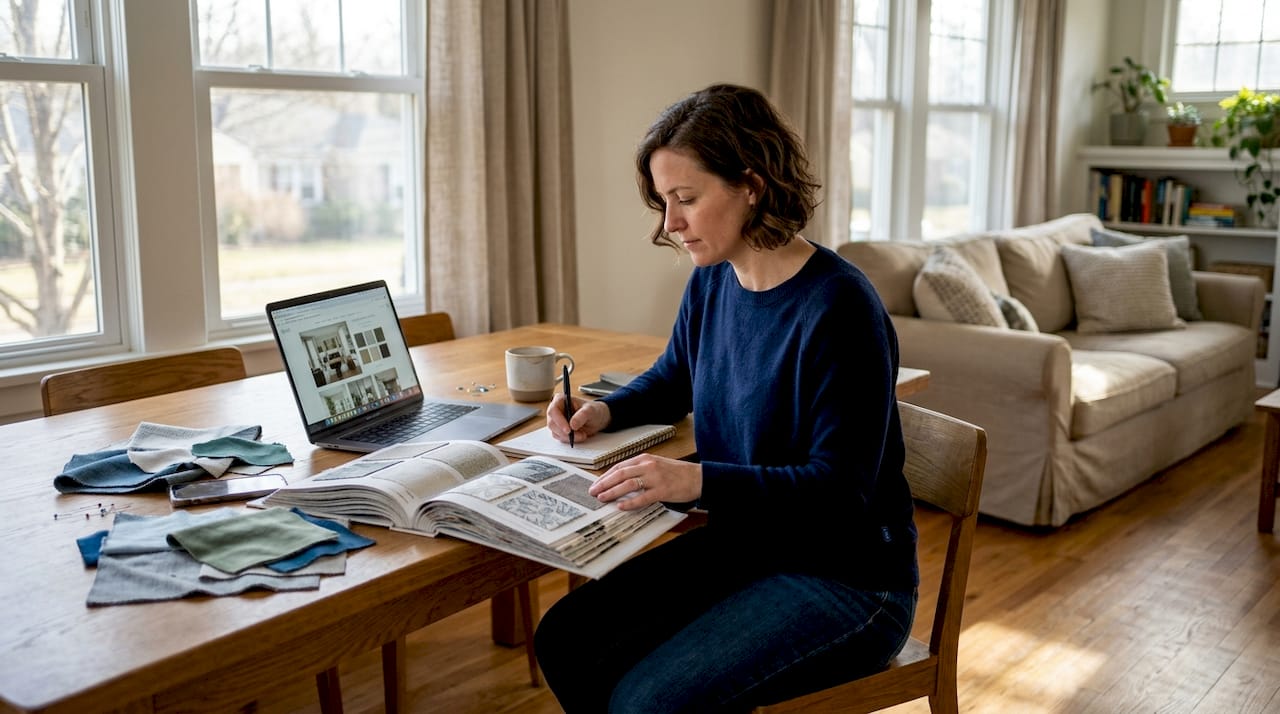
TL;DR:Knowing fabric terminology prevents costly mistakes like dimensional errors and mismatched patterns.Key terms include pattern repeat, nap direction, seam allowance, and durability ratings like Wyzenbeek rub count.Clarifying technical details with vendors ensures accurate orders, saving time and protecting project quality.
Ordering custom drapery or upholstery without knowing fabric terminology is like navigating a city without a map. One misunderstood term can mean ordering 30% too little fabric, watching a velvet sofa cushion catch the light unevenly, or receiving finished drapes that simply don’t hang right. Whether you’re a homeowner planning your first custom window treatment or an interior designer managing a full client project, a clear fabric vocabulary is the foundation of every successful result. This guide walks through the terms you’ll encounter most, explains what they actually mean in practice, and shows you how to use them confidently when shopping, ordering, or communicating with your workroom.
Table of Contents
- Why knowing fabric terminology matters for custom projects
- Essential designer fabric terms: Definitions and examples
- Reading durability: Fabric rub tests (Wyzenbeek vs. Martindale)
- Nuanced details: Pattern repeats, nap direction, and advanced jargon
- Applying terminology to real projects: Window treatments and upholstery
- Our take: The fabric vocabulary gap even design pros underestimate
- Ready to apply your new fabric vocabulary?
- Frequently asked questions
Key Takeaways
| Point | Details |
|---|---|
| Learn fabric terms first | Knowing the vocabulary prevents costly design or ordering errors. |
| Durability metrics are key | Check Wyzenbeek or Martindale ratings to match fabric to room use. |
| Pattern & nap impact outcome | Always factor in repeat and direction to avoid mismatched or wasted fabric. |
| Clarify with your workroom | Confirm important specifications with your upholsterer for a flawless result. |
Why knowing fabric terminology matters for custom projects
Fabric terminology is not just industry jargon. It directly shapes the outcome of every custom project you undertake. A single misunderstood word between you and your fabricator can result in wasted yardage, misaligned patterns, or a finish that falls short of your vision.
Consider pattern repeat, one of the most frequently misunderstood terms. Pattern repeat can increase yardage by 20 to 35%, which has a real impact on both cost and fit. If you don’t account for this when ordering, you may run short mid-project with no way to source matching fabric from the same dye lot.
Here are the key areas where terminology gaps cause the most damage:
- Pattern repeat miscalculations lead to short yardage orders and mismatched seams
- Nap direction errors on velvet or chenille create visible color variation across panels
- Durability ratings misread or ignored result in fabric that wears out far too quickly
- Seam allowance confusion causes finished dimensions to come up short
- Cleaning code misunderstandings lead to irreversible fabric damage during maintenance
A practical example: if you order velvet for a custom sofa and the workroom cuts panels without confirming nap direction, the cushions may appear to be two different colors under the same light. Correcting this means reordering and recutting, which is both costly and time-consuming.
Understanding the language of fabric also improves your communication with vendors and fabricators. When you can articulate exactly what you need, using terms like COM (customer’s own material), railroading, or Wyzenbeek count, the professionals you work with respond with greater precision. You can read more about choosing upholstery fabrics and how fabric’s role in window treatments affects every design decision you make.
The real cost of terminology confusion is not just financial. It’s the time lost, the frustration of redoing work, and the gap between the project you envisioned and the one you received.
Pro Tip: Before finalizing any order, write down every technical term your fabricator uses and confirm you share the same definition. Even experienced designers benefit from this simple step.
Now that you’re aware of what’s at stake, let’s clarify the essential terms one by one.
Essential designer fabric terms: Definitions and examples
With the context clear, it’s time to define the terms you’ll encounter most often and explain how they work in actual design scenarios.
Key upholstery fabric terms include pattern repeat, railroading, nap direction, Wyzenbeek rub count, seam allowance, and decking fabric. Each one carries specific implications for how much material you need and how the finished piece looks.
Here’s a breakdown of each term with real-world context:
- Pattern repeat: The vertical or horizontal distance before a fabric’s design repeats. Large-scale repeats require you to start each cut at the same point in the design, which wastes fabric between cuts. A sofa with a 24-inch repeat may require significantly more yardage than the same sofa in a solid.
- Nap direction: The direction in which the pile of a fabric (such as velvet or mohair) lies. All pieces must be cut in the same direction; otherwise, panels reflect light differently and appear mismatched.
- Railroading: Rotating the fabric so the pattern runs horizontally rather than vertically. Pattern matching requires starting cuts at repeat points, while railroading saves seams on plain fabrics but flips nap direction, making it unsuitable for directional textiles.
- Wyzenbeek rub count: A North American durability test measuring abrasion resistance in double rubs. Higher counts mean longer-lasting fabric.
- Seam allowance: The extra fabric beyond the finished seam line, typically 0.5 to 1 inch. Forgetting to account for seam allowance shrinks finished dimensions.
- Decking fabric: A lower-cost fabric used under seat cushions where it won’t be seen, saving your premium fabric for visible areas.
| Term | Standard use | Specialty consideration |
|---|---|---|
| Pattern repeat | Add 20-35% extra yardage | Match at seam lines |
| Railroading | Reduces seams on plains | Avoid on napped fabrics |
| Wyzenbeek count | Residential: 15,000+ rubs | Commercial: 30,000+ rubs |
| Seam allowance | 0.5 to 1 inch standard | Confirm with workroom |
| Decking fabric | Under cushions only | Use budget fabric here |
For more practical guidance, explore window treatment fabric tips and our designer fabric guide to see how these terms apply to specific fabric types.
Pro Tip: Always confirm nap direction and pattern repeat with your workroom before finalizing your yardage order. These two factors alone account for the majority of costly ordering mistakes.
Reading durability: Fabric rub tests (Wyzenbeek vs. Martindale)
With basic terms defined, you need to spot the right fabrics for the job, and a major factor is how durable they are.
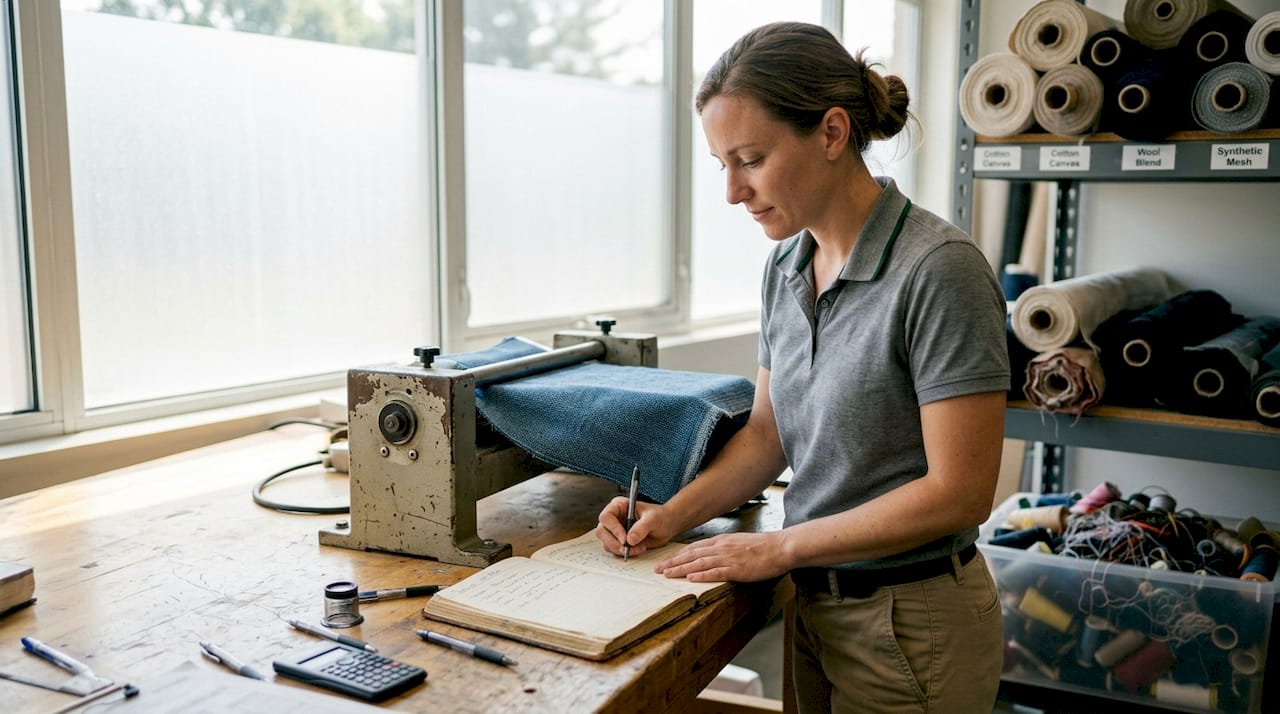
Two primary tests measure fabric abrasion resistance: the Wyzenbeek test, used predominantly in North America, and the Martindale test, favored in Europe. Both measure how well a fabric withstands rubbing, but they use different methods and produce different numbers, so you cannot directly compare them.
The Wyzenbeek and Martindale tests differ in their methodology. Wyzenbeek uses a back-and-forth motion with a wire mesh or cotton duck abradant, while Martindale uses a circular motion with wool. This means a fabric rated at 20,000 Wyzenbeek double rubs is not equivalent to 20,000 Martindale cycles.
Here is a reference table for recommended minimums:
| Use case | Wyzenbeek (double rubs) | Martindale (cycles) |
|---|---|---|
| Decorative only | Under 3,000 | Under 10,000 |
| Light residential | 3,000 to 9,000 | 10,000 to 15,000 |
| Medium residential | 9,000 to 15,000 | 15,000 to 25,000 |
| Heavy residential | 15,000 to 30,000 | 25,000 to 30,000 |
| Commercial light | 30,000+ | 30,000+ |
| Heavy commercial | 100,000+ | Not directly comparable |
Statistical callout: For a family room sofa with kids and pets, look for a minimum of 15,000 to 30,000 double rubs on the Wyzenbeek scale. Anything below 9,000 is best reserved for decorative pillows or low-traffic accent chairs.
When choosing drapery fabric, durability ratings matter less than light resistance and drape quality. But for upholstery, rub counts are non-negotiable. You can also explore how drapery fabric reduces noise and saves energy, where fabric weight and density play a larger role than abrasion ratings.
Performance fabrics, often labeled as solution-dyed or stain-resistant, typically carry higher rub counts and include cleaning codes printed on the label. These codes (W for water-based cleaners, S for solvent, WS for either, X for vacuum only) are essential to know before you buy.
Nuanced details: Pattern repeats, nap direction, and advanced jargon
Now let’s tackle terms and concepts that trip up even experienced designers and how to deal with them like a pro.
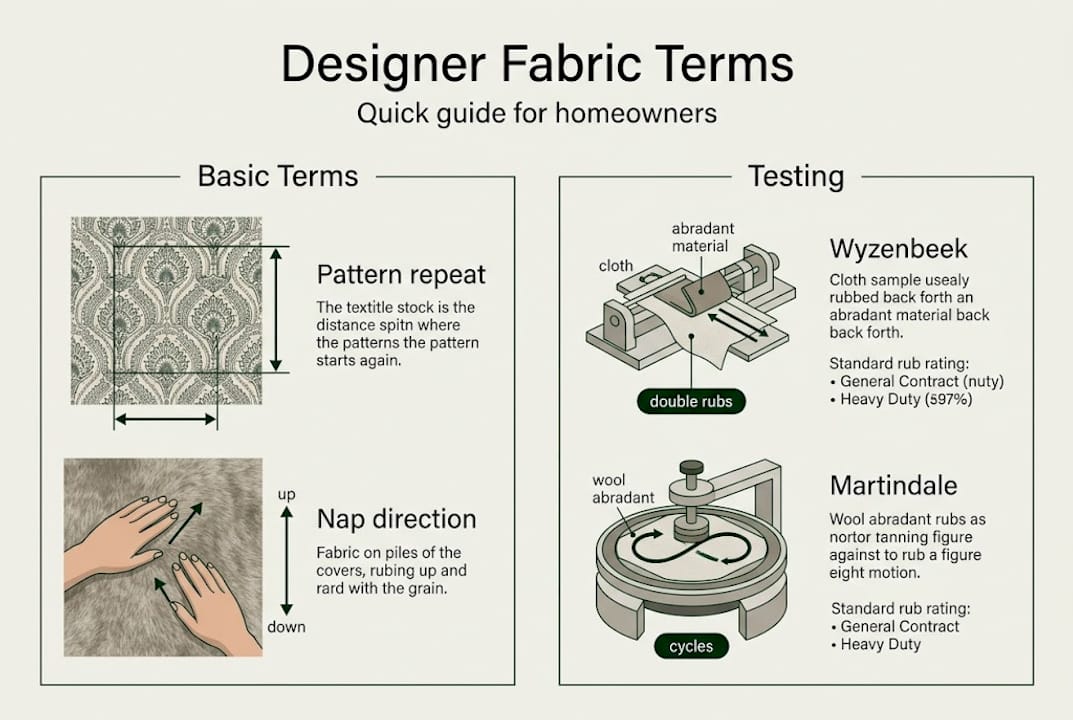
Napped fabrics add 15 to 25% more yardage due to directionality, patterned repeats increase waste further, and railroading is only appropriate for non-directional fabrics. These three factors together can dramatically change your material estimate.
Here are the nuanced terms worth knowing:
- Bias welt: Welting (the cord trim on cushion edges) cut on the diagonal of the fabric. Bias-cut welt curves more smoothly around corners and gives a refined finish, but it requires extra fabric.
- COM (customer’s own material): When you supply your own fabric to an upholsterer or workroom rather than selecting from their stock. Always confirm COM requirements, including yardage specs and fabric width, before sending material.
- Decking fabric: As noted earlier, this is the utility fabric beneath cushions. Choosing a quality decking fabric prevents seat sag over time.
- Flame retardant treatments: Some fabrics carry back-coated flame retardant finishes. Experts recommend avoiding these when possible, particularly in bedrooms, as the chemical coatings can off-gas over time. Look for inherently flame-resistant fibers instead.
- Cleaning codes: W, S, WS, and X. Misreading or ignoring these leads to permanent fabric damage.
Pro Tip: When working with large-scale patterned fabric for drapery panels, always order a sample first and mock up the repeat placement before committing to full yardage. This prevents the common mistake of centering a pattern incorrectly on a panel.
For a broader look at fabric options, browse curtain fabric types and trending curtain fabrics for 2026. If you’re working with upholstery, our guide on cleaning fabric sofas covers how cleaning codes translate into real maintenance decisions.
Applying terminology to real projects: Window treatments and upholstery
Armed with this vocabulary, let’s see how to translate these terms into direct action on your next home or client project.
For upholstery projects with heavy use, select fabrics with 30,000+ double rubs and performance finishes. For window treatments, pinch pleats with interlining deliver a luxury drape, while blackout lining is the right call for bedrooms. Knowing these distinctions before you shop saves time and prevents regret.
Here is a practical checklist for applying fabric terminology to your next project:
- Measure and calculate pattern repeat yardage. Divide your total cut length by the repeat size, round up to the next full repeat, and multiply by the number of panels or pieces needed.
- Confirm nap direction in writing. When submitting a COM order or placing a custom request, specify nap direction explicitly, not just verbally.
- Request the Wyzenbeek or Martindale rating. Ask for the actual number, not just a general description like “durable” or “heavy-duty.”
- Clarify seam allowance requirements. Different workrooms use different standards. Confirm whether their quoted dimensions include or exclude seam allowance.
- Check the cleaning code before finalizing. If the fabric will be in a high-traffic or pet-friendly space, confirm the cleaning code matches your maintenance routine.
- Specify decking fabric separately. If you’re upholstering seating, ask whether decking fabric is included in the quote or needs to be sourced separately.
For more guidance on how fabric choices translate to window treatment results, review the detailed breakdown of window treatments and fabric selection on our blog.
Our take: The fabric vocabulary gap even design pros underestimate
Here is something worth saying plainly: even experienced interior designers sometimes use these terms loosely, and that looseness has consequences. We’ve seen projects where a designer specified “railroaded” on a velvet fabric, not realizing that railroading a napped textile flips the pile direction and creates a visual mismatch across the finished piece. The correction required reordering and reupholstering, at significant cost.
The real issue is not ignorance. It’s assumption. Designers assume vendors share their definitions. Homeowners assume workrooms will catch their errors. Vendors assume the client knows what they want. Nobody checks. And when nobody checks, the gap between intent and outcome widens.
Our advice is straightforward: treat every term as a potential point of miscommunication until confirmed otherwise. Before any order is placed, review upholstery fabric selection details carefully and ask your fabricator to repeat back the key specifications. It takes five minutes and can prevent weeks of rework. Mastering this vocabulary is not about sounding knowledgeable. It’s about protecting your investment and your client relationships.
Ready to apply your new fabric vocabulary?
Understanding fabric terminology makes every step of the shopping and ordering process more precise and more confident. When you know what to ask for and how to read a product specification, you make better choices from the start.
At Beautiful Window Elgin, our curated selection of designer fabrics is organized to support informed decisions, whether you’re sourcing material for custom drapery, upholstery, or decorative accents. From durable outdoor canvas fabric to refined jacquard satins, every product listing includes the details you now know how to read. Visit us to shop designer fabrics or request a sample to see and feel the quality before you commit.
Frequently asked questions
What does ‘pattern repeat’ mean and why does it matter?
Pattern repeat is the vertical or horizontal distance until a fabric design repeats itself. Because cuts must align at repeat points, it typically requires 20 to 35% more yardage than a solid fabric of the same dimensions.
How do I know if a fabric is durable enough for heavy use?
Look for a Wyzenbeek rub count of at least 15,000 to 30,000 double rubs for heavy residential use, and 30,000 or more for commercial settings or very busy rooms.
What is the difference between nap and railroading?
Nap refers to the pile direction of fabrics like velvet, which affects how the surface reflects light. Railroading rotates fabric to run horizontally, reducing seams on wide pieces, but it is not suitable for napped or directional fabrics.
Which fabric terms should I clarify with my upholsterer?
Always confirm pattern repeat, rub count, nap direction, seam allowance, and cleaning code. Confirming COM and cleaning codes before fabrication begins prevents the most common and costly project mistakes.
Recommended
- What is designer fabric? Guide to premium textiles for homeowners – Fabric Store in Columbia, SC | Drapery Making Services
- What are designer fabrics: quality and durability guide – Fabric Store in Columbia, SC | Drapery Making Services
- Curtain Fabric Selection Guide 2026: Pick Styles That Last 30% Longer – Designer Fabrics by the Yard | Drapery Making Services
- Role of Fabric in Window Treatments– Impact on Style & Function – Shop Designer Fabrics by the Yard | Curtains & Drapery